In situ and ex situ conservation
- Syllabus
- Conservation, environmental pollution and degradation, environmental impact assessment
- As of
- October 2026
- in situ conservation
- ex situ conservation
- national park
- wildlife sanctuary
- conservation reserve
- community reserve
- tiger reserve
- eco sensitive zone
- biosphere reserve
- Man and the Biosphere programme
- core buffer and transition zones
- gene bank
- cryopreservation
- Central Zoo Authority
- 30 by 30 target
The first principle
A species is best kept where it evolved, because only there does it meet the food, mates, predators, diseases and climate that keep it wild and let it go on adapting. That is in situ conservation, and its main tool is protecting habitat. Where a population has become too small or the habitat too damaged, a copy is kept outside, in a zoo, a breeding centre, a garden or a gene bank, which is ex situ conservation. The two are not rivals: ex situ is the insurance policy, and it succeeds only when animals or seeds can one day go back to protected habitat.
The core
In situ: protected areas under the Wildlife (Protection) Act
- Wildlife sanctuary. A State Government declares its intention under Section 18 and issues the final notification under Section 26A of the Wildlife (Protection) Act, 1972 (WPA) once the Collector has settled people's rights. Some rights, such as grazing or collecting forest produce, may be allowed to continue, which is why sanctuaries are the most numerous category.
- National park. Declared under Section 35, a national park is the strictest category: no rights survive once it is notified, and grazing of livestock is not allowed. For both sanctuaries and national parks, a change of boundary needs the recommendation of the National Board for Wildlife (NBWL).
- Conservation reserve and community reserve. The amendment of 2002 added these two milder categories. A conservation reserve (Section 36A) is declared by the State on land it owns, usually a corridor or a buffer next to a park, after consulting local communities; a community reserve (Section 36C) is declared on community or private land where the people themselves volunteer to conserve. Both keep local use and are run with a management committee.
- Tiger reserve. Under Section 38V, added by the amendment of 2006 that also created the National Tiger Conservation Authority (NTCA), a tiger reserve has a core or critical tiger habitat kept inviolate for tigers, and a buffer where people and wildlife share the land under regulation. It is laid over parks and sanctuaries rather than being a separate land category.
- Eco sensitive zone. Around a protected area the Centre notifies an eco sensitive zone (ESZ) under the Environment (Protection) Act, 1986, listing activities that are prohibited, regulated or permitted. The often quoted 10 km is only a default in the 2011 guidelines, which allow a narrower or wider zone. On 3 June 2022 the Supreme Court ordered a uniform ESZ of at least 1 km, and on 26 April 2023 it relaxed this as unworkable, keeping only the ban on mining in and near parks and sanctuaries.
Layers that are not land categories
- Biosphere reserves. Under the Man and the Biosphere (MAB) programme that the United Nations Educational, Scientific and Cultural Organization (UNESCO) began in 1971, a biosphere reserve joins conservation with research and local livelihoods across three zones: a protected core, a buffer for research and education, and a transition zone where people live and work. India notifies them administratively, without a law of their own, and has 18; 13 are in UNESCO's World Network of Biosphere Reserves, the latest being the Cold Desert Biosphere Reserve of Himachal Pradesh in September 2025. Nilgiri, notified in 1986, was the first.
- Other designations. Ramsar sites (see the wetlands note), elephant reserves under Project Elephant, critical wildlife habitats under the Forest Rights Act, 2006, and UNESCO World Heritage Sites are labels laid over land that may or may not be a protected area.
Ex situ: keeping a copy
- Zoos and conservation breeding. The Central Zoo Authority, created by the amendment of 1991 to the WPA, recognises and regulates zoos and coordinates breeding of endangered species. Examples are the Jatayu Conservation Breeding Centre at Pinjore in Haryana for vultures and the breeding centres in Jaisalmer, Rajasthan, for the Great Indian Bustard (Ardeotis nigriceps; Critically Endangered, Schedule I, CITES Appendix I).
- Gene banks and seed banks. Seeds of most crops survive for decades when dried and kept at about minus 18 °C, so the National Gene Bank of the National Bureau of Plant Genetic Resources in New Delhi holds the country's base collection of crop seeds. Seeds that cannot be dried, as well as sperm, eggs and embryos, are kept by cryopreservation in liquid nitrogen at minus 196 °C, where metabolism effectively stops.
- Wildlife biobanking. The Laboratory for the Conservation of Endangered Species (LaCONES) of the Centre for Cellular and Molecular Biology at Hyderabad stores genetic material of wild animals and supports assisted reproduction.
- Botanical gardens and field gene banks. Living collections such as the Acharya Jagadish Chandra Bose Indian Botanic Garden at Howrah, founded in 1787, keep plants whose seeds do not store well, while the Svalbard Global Seed Vault in Norway (2008) holds backup copies of seed collections from around the world.
Dimensions
- Ecological. In situ conservation protects processes, such as predation, migration, pollination and fire, that no zoo can keep, while ex situ conservation keeps genes that could otherwise vanish in a single bad year.
- Social. Protected areas often overlap with the homes and commons of forest dwellers, and relocation from core areas has been contested; the Forest Rights Act, 2006 requires that rights be recognised before an area is made inviolate, and the 2002 reserves were designed to protect habitat without eviction.
- Landscape. Animals do not respect boundaries, so a park works only if corridors connect it with others; conservation reserves, tiger reserve buffers and biosphere transition zones extend protection into the working landscape.
- Economic. Parks generate tourism and protect watersheds, while ESZ rules restrict mining and construction around them, so they create both local gains and local costs.
- International. Target 3 of the Kunming–Montreal Global Biodiversity Framework (2022) asks countries to conserve 30 per cent of land and sea by 2030 through protected areas and other effective area based conservation measures (OECMs), such as sacred groves and community lands.
In practice
- The numbers. The National Wildlife Database of the Wildlife Institute of India (WII), updated in November 2023, listed 1,014 protected areas covering about 1,75,169 square km, or about 5.3 per cent of India's land: 106 national parks, 573 wildlife sanctuaries, 115 conservation reserves and 220 community reserves.
- A moving count. The Ministry of Environment, Forest and Climate Change (MoEFCC) adds new areas every year, and most of the growth since 2014 has come from conservation and community reserves, so a count should always be quoted with its date and source.
- Tiger reserves and ESZs. India had 58 tiger reserves covering about 85,000 square km in 2025, and final ESZ notifications had been issued for several hundred protected areas (MoEFCC, December 2025).
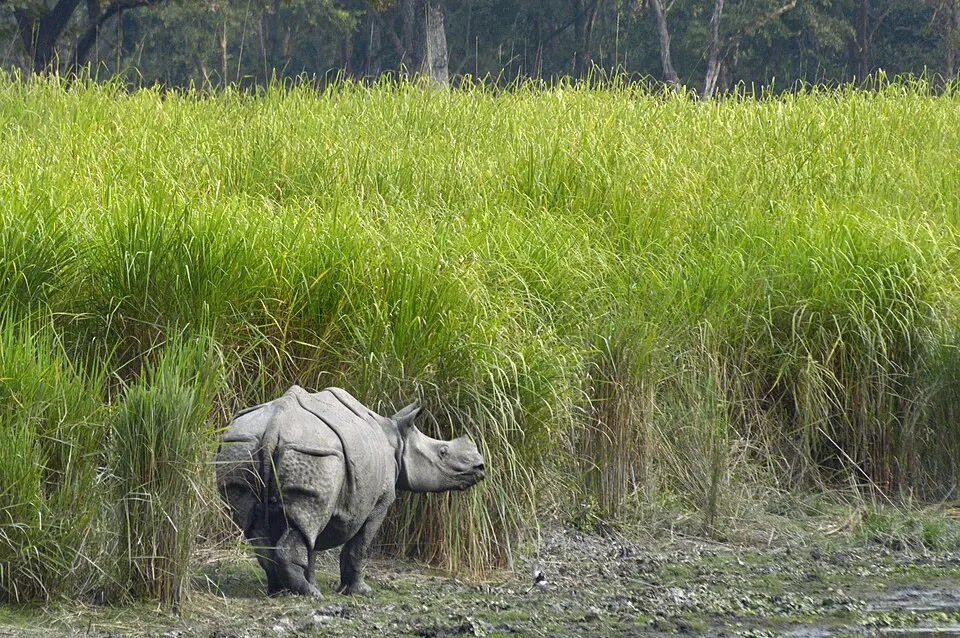
- Kaziranga. Kaziranga in Assam is at once a national park, a tiger reserve and a World Heritage Site, which shows how designations stack on one piece of land; its floodplain grasslands hold most of the world's greater one horned rhinoceros (Rhinoceros unicornis; Vulnerable, Schedule I, CITES Appendix I).
- Reintroduction as a bridge. The cheetah project at Kuno, begun in September 2022 with animals from Namibia and South Africa, combines ex situ care in enclosures with release into a protected habitat, and its difficulties show how much a reintroduction depends on prey, space and management.

Issues and way forward
- Small and isolated parks. Most Indian protected areas are small, so populations inside them are prone to inbreeding and local extinction; securing corridors as conservation reserves and building crossings on roads and railways would connect them.
- People and parks. Evictions from core areas without recognised rights breed conflict and weaken local support; voluntary, well compensated relocation and community reserves give a better result, as the growth in community reserves since 2014 suggests.
- Weak legal backing for some layers. Biosphere reserves and elephant reserves have no statutory status of their own, so their protection depends on the laws covering the land underneath; giving them a clearer legal footing would help.
- ESZ delays and dilution. Many ESZs took years to be notified and some were made very narrow, so clear scientific criteria for their width, applied case by case, are needed.
- Ex situ without a way back. A breeding programme that never releases animals becomes a museum, so every programme should have a release plan, habitat secured for it and long term monitoring.
Common confusions
- National park and wildlife sanctuary. Both are declared by the State under the WPA, but rights may continue in a sanctuary while none survive in a national park.
- Conservation reserve and community reserve. A conservation reserve is on government land declared by the State, while a community reserve is on community or private land where the people choose to conserve.
- Biosphere reserve and protected area. A biosphere reserve is a UNESCO linked designation with no law of its own and people living in its transition zone, while a protected area is a legal category under the WPA.
- ESZ and buffer zone. An ESZ is notified under the Environment (Protection) Act around a protected area, while the buffer of a tiger reserve is part of the reserve itself under the WPA.
- Reintroduction and translocation. Reintroduction returns a species to an area where it had become extinct, such as the cheetah at Kuno, while translocation moves animals between places where the species already exists.
For the exam
- Keyword bank: in situ conservation, ex situ conservation, inviolate core, buffer zone, community reserve, conservation reserve, eco sensitive zone, biosphere reserve, transition zone, corridor, conservation breeding, gene bank, cryopreservation, OECMs, 30 by 30.
- Previous year questions: Practise the previous year questions on this topic →
- Use in an answer:
- Introduction with data: India's protected areas, 106 national parks, 573 sanctuaries and 335 conservation and community reserves, cover only about 5.3 per cent of its land (Wildlife Institute of India, 2023).
- Introduction with a judgement: In April 2023 the Supreme Court withdrew its own order for a uniform 1 km eco sensitive zone, holding that buffers around protected areas must be site specific.
- Conclusion: Protected areas save species only when they are connected and supported by the people who live around them, which is why corridors and community reserves matter as much as new parks.
- Conclusion: Ex situ conservation buys time, but the real test of a breeding centre or a gene bank is whether its animals and seeds return to a living landscape.