Forests of India
- Syllabus
- Conservation, environmental pollution and degradation, environmental impact assessment
- As of
- October 2026
- India State of Forest Report
- forest cover
- tree cover
- recorded forest area
- canopy density classes
- Champion and Seth classification
- carbon stock
- carbon sink target
- Compensatory Afforestation Fund Act 2016
- CAMPA
- net present value
- Green India Mission
- Van (Sanrakshan Evam Samvardhan) Adhiniyam
- Godavarman case
- National Forest Policy 1988
The first principle
A forest is not a set of trees but a system: a canopy, an understorey, a soil built over centuries, and the animals, fungi and people that live by it. A count of green canopy from space can tell how much land is shaded by trees, but not whether that shade is an old sal forest or a young eucalyptus plantation. Most debates on India's forests, from the forest report to compensatory planting, turn on this gap between canopy and ecosystem. (Natural vegetation as a part of physical geography is covered in GS1 Geography.)
The core
How India measures its forests
- The report. The Forest Survey of India (FSI), Dehradun, publishes the India State of Forest Report (ISFR) every two years. The latest, ISFR 2023, released on 21 December 2024, is the eighteenth since 1987. It maps canopy from Indian Remote Sensing satellite imagery at a scale of 1:50,000 and checks it on the ground.
- Forest cover. All land of one hectare or more with tree canopy density above 10 per cent, whatever its ownership, legal status or land use, so orchards, bamboo and plantations count.
- Canopy classes. Very dense forest has a canopy density of 70 per cent or more, moderately dense forest 40 to 70 per cent, and open forest 10 to 40 per cent; scrub is degraded forest land with a canopy below 10 per cent.
- Tree cover. Patches of trees smaller than one hectare outside the recorded forest area, such as trees on farms, along roads and in towns.
- Recorded forest area. Land notified as forest in government records (reserved, protected or unclassed), which is a legal category: some recorded forest has little canopy, and much canopy lies outside recorded forest.
Forest types
- The classification. H G Champion and S K Seth's A Revised Survey of the Forest Types of India (1968) groups India's forests into 16 type groups and about 200 types, according to rainfall, temperature and altitude, and FSI still uses it.
- Five broad classes. Tropical forests (wet evergreen, semi evergreen, moist deciduous, littoral and swamp, dry deciduous, thorn and dry evergreen), subtropical forests (broadleaved hill, pine and dry evergreen), montane temperate forests (wet temperate, Himalayan moist and Himalayan dry), sub alpine forests and alpine scrub make up the 16 groups.
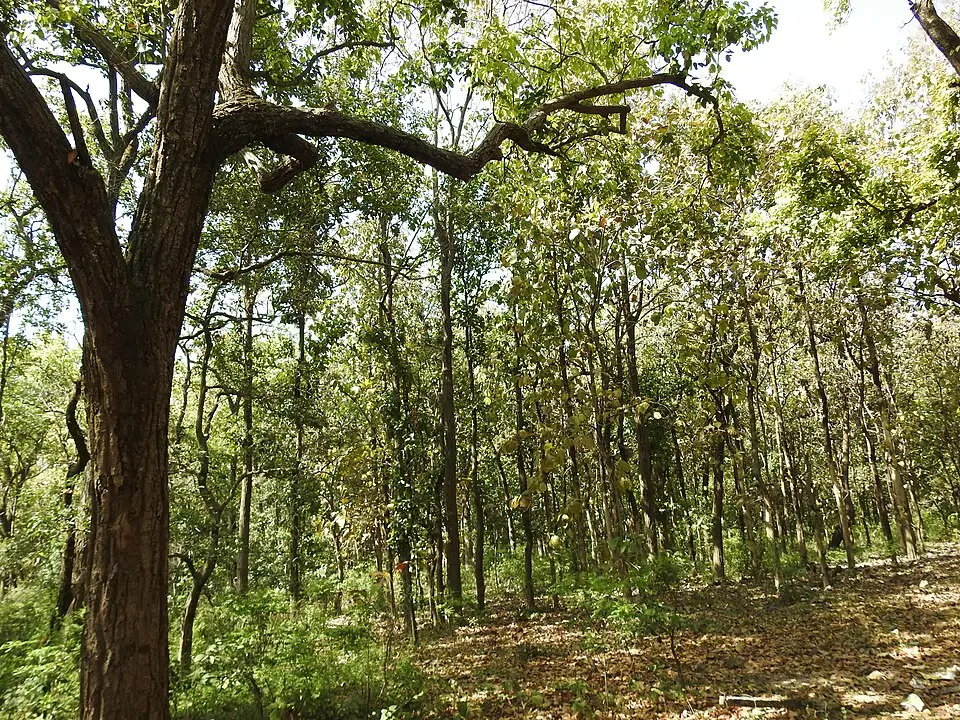
- What dominates. Tropical dry deciduous forests cover the largest share of India's forest area, followed by tropical moist deciduous forests; sal (Shorea robusta) and teak (Tectona grandis) are their typical trees.

The legal frame
- Constitution. The Forty Second Amendment of 1976 moved forests and the protection of wild animals from the State List to the Concurrent List, and added Article 48A (the State shall protect forests and wildlife) and Article 51A(g) (every citizen's duty to protect them).
- Laws. The Indian Forest Act, 1927 creates reserved, protected and village forests; the Forest (Conservation) Act, 1980 requires the Centre's approval before forest land is diverted, and the amendment of 2023 renamed it the Van (Sanrakshan Evam Samvardhan) Adhiniyam, 1980. The Forest Rights Act, 2006 recognises the rights of forest dwellers (see the wildlife and forest laws note).
- Policy. The National Forest Policy, 1988 set the goal of one third of India's area under forest or tree cover, and two thirds in the hills.
Dimensions
- Ecological. Forests hold most of India's land biodiversity, regulate rivers by storing water in soil and releasing it slowly, and check erosion in the hills.
- Climate. Forests are India's main land carbon sink: ISFR 2023 put forest carbon stock at 7,285.5 million tonnes, an increase of 81.5 million tonnes over the previous assessment.
- Social. Tens of millions of forest dwellers, many of them Scheduled Tribes, depend on forests for fuel, fodder, food and minor forest produce, so forest policy is also tribal policy.
- Economic. Timber, bamboo and non timber forest produce support local economies; ISFR 2023 put India's growing stock at 6,430 million cubic metres, nearly a third of it outside forests.
- Regional. Madhya Pradesh has the largest forest cover by area, followed by Arunachal Pradesh and Chhattisgarh, while Lakshadweep, Mizoram and the Andaman and Nicobar Islands have the highest shares of their area under forest.
In practice
- The headline numbers. ISFR 2023 put forest cover at 7,15,343 square km (21.76 per cent of the country) and tree cover at 1,12,014 square km (3.41 per cent), so forest and tree cover together reached 8,27,357 square km or 25.17 per cent. Compared with 2021, the total rose by 1,445 square km, of which forest cover added only 156 square km and tree cover 1,289 square km.
- The carbon target. India's Nationally Determined Contribution (NDC) of 2015 promised an additional carbon sink of 2.5 to 3 billion tonnes of carbon dioxide equivalent by 2030 over 2005; ISFR 2023 estimated 2.29 billion tonnes achieved.
- Compensatory afforestation. When forest land is diverted, the user agency pays for planting an equal area of non forest land, or twice the area of degraded forest land, plus the net present value (NPV) of the forest lost, which the Supreme Court began to require in the T N Godavarman case in 2002. The Compensatory Afforestation Fund Act, 2016 placed this money in public accounts, with 90 per cent in State funds and 10 per cent in the National Fund, managed by the Compensatory Afforestation Fund Management and Planning Authority (CAMPA) at both levels.
- Green India Mission. One of the eight missions of the National Action Plan on Climate Change (2008), approved in 2014, it aims to raise forest and tree cover and improve forest quality over 10 million hectares, with a revised mission document issued in 2025.
- Other programmes. The Nagar Van Yojana (2020) creates city forests; the Ek Ped Maa Ke Naam campaign of June 2024 asks citizens to plant a tree in their mother's name; and the Green Credit Programme of 2023 awards credits for planting on degraded land.
- A judgement that still governs. In T N Godavarman Thirumulpad v Union of India (1996) the Supreme Court held that "forest" must be understood in its dictionary sense, covering any forest whatever its ownership, and in February 2024 it directed that this wide meaning continue to apply after the 2023 amendment.
- International standing. The Food and Agriculture Organization's Global Forest Resources Assessment 2025 ranked India ninth in the world in forest area and third in annual net gain.
Issues and way forward
- Canopy is not forest. Because plantations and orchards count as forest cover, gains on paper can hide losses of natural forest, especially in the Northeast; reporting natural forest and plantations separately would make the numbers honest.
- Gains come mostly from trees outside forests. Between 2021 and 2023 tree cover grew eight times as much as forest cover, so the national target of one third depends on farms and towns, which agroforestry policy and easier rules for felling and transport of farm timber would support.
- Compensatory planting of poor quality. Plantations are often of a few fast growing species on scattered or degraded land, far from the forest lost; the Comptroller and Auditor General's audit of 2013 also found funds misused. Native species, assisted natural regeneration and planting next to existing forests would serve ecology better.
- Dilution through exemptions. The 2023 amendment exempted land within 100 km of the borders for strategic linear projects and small areas for security and roadside facilities, which critics fear will fragment frontier forests; strict project wise scrutiny and public data on diversions are the safeguards.
- Fires and invasives. Forest fires and weeds such as Lantana degrade the forest that stands, so fire lines, community fire watchers and weed removal deserve as much money as new planting.
Common confusions
- Forest cover and recorded forest area. Forest cover is canopy seen from a satellite on any land, while recorded forest area is land notified as forest in government records.
- Forest cover and tree cover. Forest cover is patches of one hectare or more; tree cover is smaller patches outside recorded forest.
- Carbon stock and carbon sink. Carbon stock is the total carbon held in forests at one time, while the sink in India's NDC is the additional carbon dioxide absorbed compared with 2005.
- CAMPA and the Green India Mission. CAMPA spends money paid by those who divert forest land, while the Green India Mission is a centrally sponsored programme funded from the budget, though the two are often combined on the ground.
- Afforestation and reforestation. Afforestation plants trees on land that was not forest, while reforestation restores trees on land that was recently forest.
For the exam
- Keyword bank: forest cover, tree cover, recorded forest area, canopy density, Champion and Seth, carbon stock, additional carbon sink, net present value, Compensatory Afforestation Fund, CAMPA, Green India Mission, assisted natural regeneration, Van (Sanrakshan Evam Samvardhan) Adhiniyam, Godavarman, trees outside forests.
- Previous year questions: Practise the previous year questions on this topic →
- Use in an answer:
- Introduction with data: Forest and tree cover reached 25.17 per cent of India's area in ISFR 2023, still well short of the one third set by the National Forest Policy of 1988.
- Introduction with a judgement: In the Godavarman case (1996) the Supreme Court read "forest" in its dictionary sense, bringing every forest under the Forest (Conservation) Act whatever its ownership.
- Conclusion: India's forest numbers rise mainly through trees outside forests and plantations, so the next step is to protect and restore natural forest, not only to add canopy.
- Conclusion: With a carbon sink target of 2.5 to 3 billion tonnes in its Nationally Determined Contribution, India has made forests part of climate policy, and their success will depend on the people who live in and around them.