Mangroves, coral reefs and coasts
- Syllabus
- Conservation, environmental pollution and degradation, environmental impact assessment
- As of
- October 2026
- mangroves
- pneumatophores
- vivipary
- blue carbon
- MISHTI
- coral polyp
- zooxanthellae
- coral bleaching
- degree heating weeks
- ocean acidification
- fringing barrier and atoll reefs
- Coastal Regulation Zone Notification 2019
- no development zone
- Coastal Zone Management Authority
- Mangrove Alliance for Climate
The first principle
The coast is where land, sea and fresh water meet, and life there must cope with salt, tides, waves and shifting sediment. Two groups of living things have turned these stresses into an advantage: mangrove trees, which tolerate salt and waterlogging, and reef building corals, which live in partnership with algae in clear, warm, nutrient poor seas. Both build the coast they live on, by trapping mud or laying down limestone, and both break the force of waves. Coastal law in India, the Coastal Regulation Zone rules, rests on keeping these natural defences and the people who depend on them in place.
The core
Mangroves
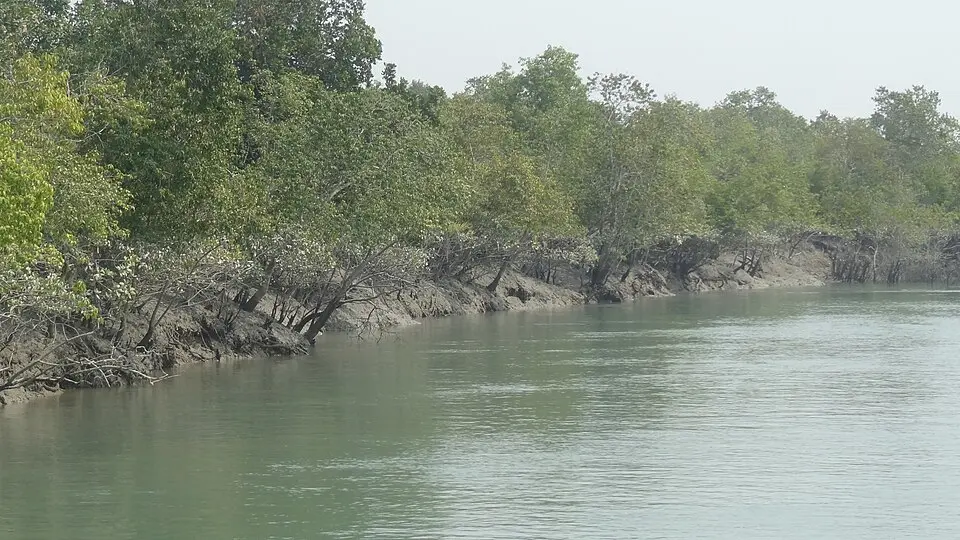
- What they are. Mangroves are salt tolerant trees and shrubs of the intertidal zone of tropical and subtropical coasts, sheltered estuaries, deltas and lagoons where fine mud collects.
- How they cope. Mud flooded twice a day has almost no oxygen, so trees such as Avicennia send up breathing roots (pneumatophores) and Rhizophora stands on arching stilt roots. Some species keep salt out at the roots and others excrete it through glands in their leaves. In Rhizophora the seed germinates while still on the tree (vivipary), so the seedling drops ready to root in the mud.
- Why they matter. Their roots slow water so that silt settles and the shore builds outwards, they absorb wave and storm surge energy, and they are nurseries for fish, crabs and prawns. Mangrove soils, waterlogged and slow to decay, store far more carbon per hectare than most land forests, which makes mangroves, seagrass and salt marshes the main stores of blue carbon.

Coral reefs
- The builders. A coral reef is built by colonies of tiny animals, coral polyps of the class Anthozoa, related to jellyfish. Each polyp lays down a skeleton of calcium carbonate (CaCO₃) and keeps single celled algae, the zooxanthellae, inside its tissue. The algae photosynthesise and pass most of the food they make to the polyp, and in return get shelter, carbon dioxide and nutrients.
- Where they grow. Because the algae need light, reef building corals grow in shallow, clear, warm and salty water, roughly between 30° N and 30° S, and are absent where large rivers bring silt and fresh water.
- Reef forms. A fringing reef grows along the shore, a barrier reef is separated from the shore by a lagoon, and an atoll is a ring of reef around a lagoon where a volcanic island has sunk. India's reefs lie in the Gulf of Kachchh, the Gulf of Mannar, Lakshadweep (atolls) and the Andaman and Nicobar Islands (mostly fringing), with smaller patches on the west coast.
- Trade rules. All stony corals are listed in Appendix II of the Convention on International Trade in Endangered Species of Wild Fauna and Flora (CITES), so they cross borders only under permit; their protection under Indian wildlife law is covered in the aquatic and marine species note.
Why corals bleach
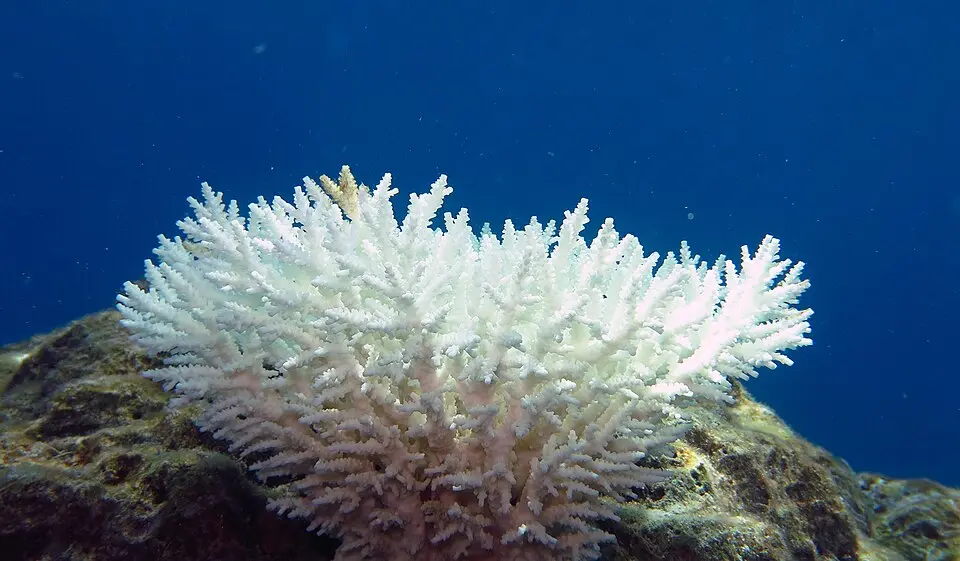
- The mechanism. When sea temperature stays about 1 °C or more above the warmest monthly average for weeks, the photosynthetic machinery of the algae is damaged and they produce harmful reactive oxygen molecules. The coral expels them, its tissue becomes almost transparent and the white skeleton shows through, which is bleaching. A bleached coral is alive but starving; it recovers if the water cools within weeks and dies if the heat lasts.
- Measuring heat stress. The United States National Oceanic and Atmospheric Administration (NOAA) adds up heat above the bleaching threshold over twelve weeks as degree heating weeks: about 4 °C weeks brings significant bleaching and about 8 °C weeks brings severe bleaching and deaths.
- Acidification adds to it. Carbon dioxide dissolving in seawater forms carbonic acid (CO₂ + H₂O ⇌ H₂CO₃ ⇌ H⁺ + HCO₃⁻), and the extra hydrogen ions combine with carbonate ions (H⁺ + CO₃²⁻ → HCO₃⁻), leaving fewer carbonate ions for corals to build skeletons with.

Dimensions
- Disaster. Mangroves and reefs absorb wave and surge energy; villages behind the mangroves of Odisha suffered fewer deaths in the super cyclone of 1999, and mangroves at Pichavaram in Tamil Nadu reduced damage in the tsunami of 2004.
- Economic. Reefs and mangroves sustain coastal fisheries and tourism, and the people of Lakshadweep live on islands that are themselves built by corals.
- Climate. Blue carbon ecosystems absorb carbon, but warming, sea level rise and acidification now threaten them, so they are both a solution and a casualty of climate change.
- Biodiversity. Reefs hold a disproportionately large share of marine species for their small area, and the Sundarbans shelter the only mangrove tigers in the world.
- Social. Fishers have customary use of the beach and the near shore, which coastal construction and tourism displace, so coastal regulation is also a question of livelihoods.
In practice
- The coast. India's coastline measures 11,098.81 km by the remeasurement of the National Hydrographic Office and the Survey of India, against the older figure of 7,516.6 km, because modern mapping follows the coast in finer detail.
- Mangrove cover. The India State of Forest Report (ISFR) 2023 put mangrove cover at 4,991.68 square km, about 0.15 per cent of the country, up 363.68 square km since 2013. Mangroves occur along the coasts of nine States and of several Union Territories; West Bengal, with the Sundarbans, has the largest share, followed by Gujarat and the Andaman and Nicobar Islands.
- MISHTI. The Mangrove Initiative for Shoreline Habitats and Tangible Incomes, launched on 5 June 2023, aims to develop about 540 square km of mangroves along the coast, implemented by coastal States with funding from the Compensatory Afforestation Fund and in convergence with the rural employment guarantee scheme.
- Other programmes. Under the National Coastal Mission, a component for mangroves and coral reefs supports 38 mangrove sites and four coral reef sites, and India joined the Mangrove Alliance for Climate launched by the United Arab Emirates and Indonesia at the 27th Conference of the Parties to the climate convention (COP27) in 2022.
- The fourth global bleaching. NOAA's fourth global coral bleaching event, which began in early 2023, is the most extensive on record: by 2025 bleaching level heat stress had reached about 84 per cent of the world's reef area, and mass bleaching was recorded in more than 80 countries and territories, including India's reefs.
- Coastal Regulation Zone (CRZ) Notification, 2019. Issued under the Environment (Protection) Act, 1986 and based on the report of the Shailesh Nayak Committee, it replaced the notification of 2011, which had itself replaced that of 1991. It divides the coast into CRZ I (A: ecologically sensitive areas such as mangroves, corals and turtle nesting beaches; B: the intertidal zone), CRZ II (developed urban areas), CRZ III (rural areas, with a no development zone of 50 metres from the high tide line in densely populated CRZ III A and 200 metres in CRZ III B) and CRZ IV (the water area up to 12 nautical miles and tidal water bodies). Mangrove patches larger than 1,000 square metres get a 50 metre buffer, and islands close to the mainland and in backwaters have a 20 metre no development zone. Clearances for CRZ I and IV stay with the Centre, while those for CRZ II and III were delegated to the States.
- Institutions and a judgement. In Indian Council for Enviro Legal Action v Union of India (1996), the Supreme Court directed the setting up of Coastal Zone Management Authorities to enforce the rules, which now exist at the national level and in every coastal State.
Issues and way forward
- Relaxation and enforcement. The 2019 Notification narrowed the no development zone in dense rural areas and eased tourism and housing, while enforcement of even the older rules was weak; finalised Coastal Zone Management Plans, satellite monitoring and public data on violations would help.
- Plantations that fail. Mangrove planting often uses one species on mudflats where mangroves never grew, and many seedlings die; restoring tidal flow and natural regeneration, with community management, works better.
- Heat beyond repair. Reefs cannot be protected from warming by local action alone, but cutting local stresses such as sewage, sediment and destructive fishing helps them recover between heatwaves, and reef restoration buys time only if global emissions fall.
- Coastal squeeze. As sea level rises, mangroves need to move inland, but sea walls and buildings block them, so planning should leave room behind them.
- Sand and sediment. Dams hold back river sediment and ports and sea walls disrupt longshore drift, which erodes deltas and beaches; sediment management should be part of every coastal project's impact assessment.
Common confusions
- Bleaching and death. A bleached coral is alive but has lost its algae; it dies only if the stress lasts long enough to starve it.
- Mangroves and other wetlands. Mangroves are counted in forest cover by the forest report and are also wetlands under the Ramsar Convention, so they appear in both statistics.
- Fringing reef and barrier reef. A fringing reef touches the shore, while a barrier reef is separated from it by a lagoon.
- CRZ I A and CRZ I B. CRZ I A is ecologically sensitive areas, such as mangroves and corals, while CRZ I B is the intertidal zone between the low and high tide lines.
- Acidification and warming. Warming causes bleaching through the algae, while acidification slows skeleton building through carbonate chemistry; both come from carbon dioxide but act differently.
For the exam
- Keyword bank: intertidal zone, pneumatophores, vivipary, blue carbon, MISHTI, coral polyp, zooxanthellae, bleaching, degree heating weeks, ocean acidification, atoll, CRZ 2019, no development zone, high tide line, Coastal Zone Management Authority.
- Previous year questions: Practise the previous year questions on this topic →
- Use in an answer:
- Introduction with data: India's mangrove cover stood at 4,991.68 square km in 2023, only 0.15 per cent of the country, yet these forests guard the deltas of the east coast against cyclones (ISFR 2023).
- Introduction with a report: During the fourth global bleaching event, which began in 2023, about 84 per cent of the world's reef area faced bleaching level heat stress (NOAA, 2025).
- Conclusion: Mangroves and reefs are the cheapest sea walls India has, so protecting them under the Coastal Regulation Zone rules is climate adaptation as much as conservation.
- Conclusion: Local care can help reefs survive between heatwaves, but their long term future depends on how fast the world cuts carbon dioxide emissions.