Medieval India: technology and syncretism
- Syllabus
- Indian culture will cover the salient aspects of Art Forms, Literature and Architecture from ancient to modern times.
- As of
- October 2026
- charkha
- carder's bow
- Persian wheel
- paper
- lime mortar
- iron stirrup
- iqta
- urban revolution
- sulh i kul
- Ibadat Khana
- Mahzar
- Din i Ilahi
- Razmnama
- Maktab Khana
- Indo Persian culture
The first principle
The Turkish conquest of north India in the thirteenth century joined India to a larger Islamic world that stretched from Spain to Central Asia, and techniques that had moved across that world for centuries now reached Indian workshops, fields and armies. Technology changes society when it lowers the cost of something people already need: cloth, water, writing, buildings or war. In the same way, Akbar's religious policy grew from a practical need, since a small Muslim ruling class governing a mostly non Muslim people could rule securely only by standing above sects and drawing all of them into the state.
The core
Technological changes of the Sultanate period
Irfan Habib, in his studies of medieval technology, shows that several devices first appear in Indian sources between the thirteenth and fifteenth centuries.
- Building techniques. The true arch, the dome and lime mortar let builders roof wide halls quickly, so new cities, forts and mosques rose across the north (details in the note on Indo Islamic architecture).
- Paper. Paper had reached Sind earlier, but its general use in north India dates from the Sultanate. It was cheaper than palm leaf or birch bark, so it made books, letters and, above all, government records far more common.
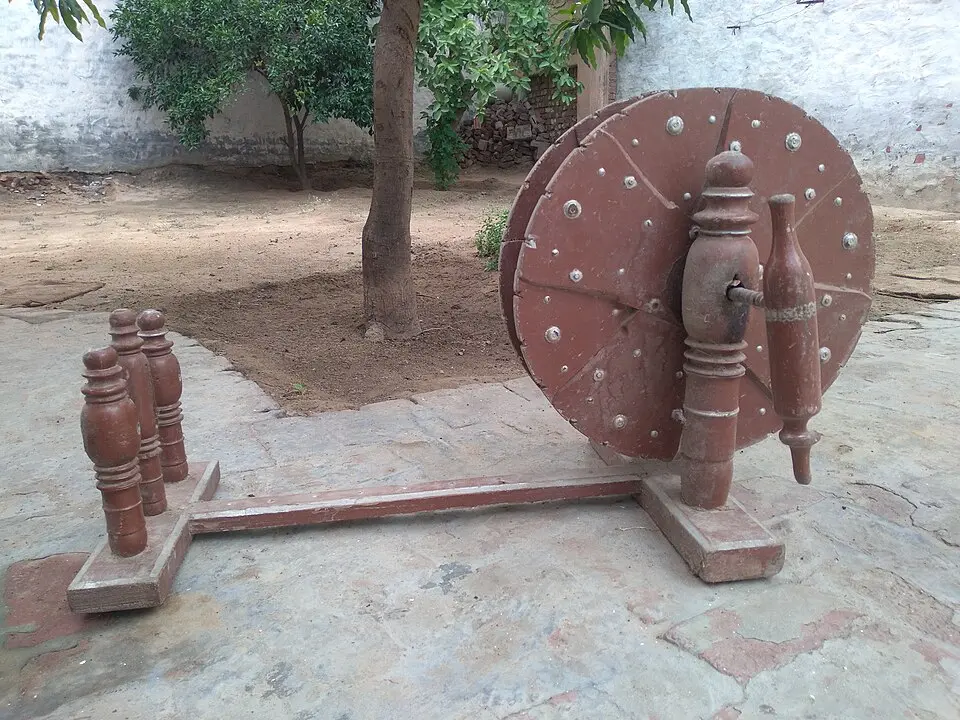
- The spinning wheel (charkha) and the carder's bow (dhunia's kaman). The charkha is first clearly mentioned in the fourteenth century, and Habib estimates that it multiplied a spinner's output several times compared with the hand spindle. The carder's bow, a string struck to fluff and clean cotton, removed another bottleneck.
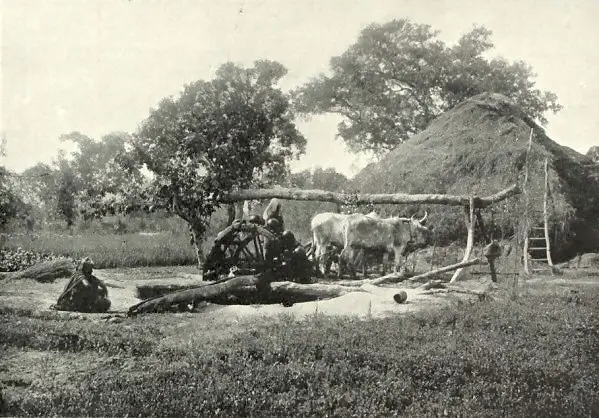
- The Persian wheel (saqiya). A geared wheel turned by bullocks lifts a chain of pots from a well continuously. Babur, in his memoirs, describes it as the main means of irrigation around Lahore and Dipalpur.
- Cavalry equipment. The iron stirrup and the nailed horseshoe gave the Turkish mounted archer a stable seat and a durable horse, which explains much of the speed of their conquests.
- Later additions. Gunpowder weapons spread in the fifteenth century and Babur's field artillery decided Panipat in 1526; silkworm rearing (sericulture) expanded in Bengal; and distillation, which some scholars date to this period, made new products possible.

How these changes influenced Indian society
- Towns and crafts. Mohammad Habib called the result an urban revolution: Delhi, Daulatabad, Jaunpur and other towns grew, and new artisan groups such as paper makers, carders, masons and weavers multiplied. Ibn Battuta describes Delhi as one of the largest cities of the Islamic world.
- Cloth and trade. Cheaper yarn meant cheaper cloth, which widened the market at home and fed the export trade from Gujarat and Bengal.
- Agriculture. The Persian wheel brought more land under irrigation in Punjab and the north west, encouraging a second crop and cash crops.
- State and literacy. Paper and Persian administration created a class of literate clerks and accountants, joined over time by Kayasthas and Khatris who learnt Persian, and made a cash revenue system possible.
- Warfare and the iqta. Revenue assignments (iqtas) were given to officers who maintained cavalry, so the new military technology and the land revenue system grew together.
- Limits. Change was uneven: villages kept older ploughs and tools, and much of the technology served the court and the army first.

Akbar's religious syncretism
- Early steps. Akbar married into the Kachhwaha house of Amber (1562), stopped the enslavement of prisoners of war (1562), abolished the pilgrimage tax (1563) and abolished jizya (1564). These were acts of state policy that built trust with Rajputs and Hindu subjects.
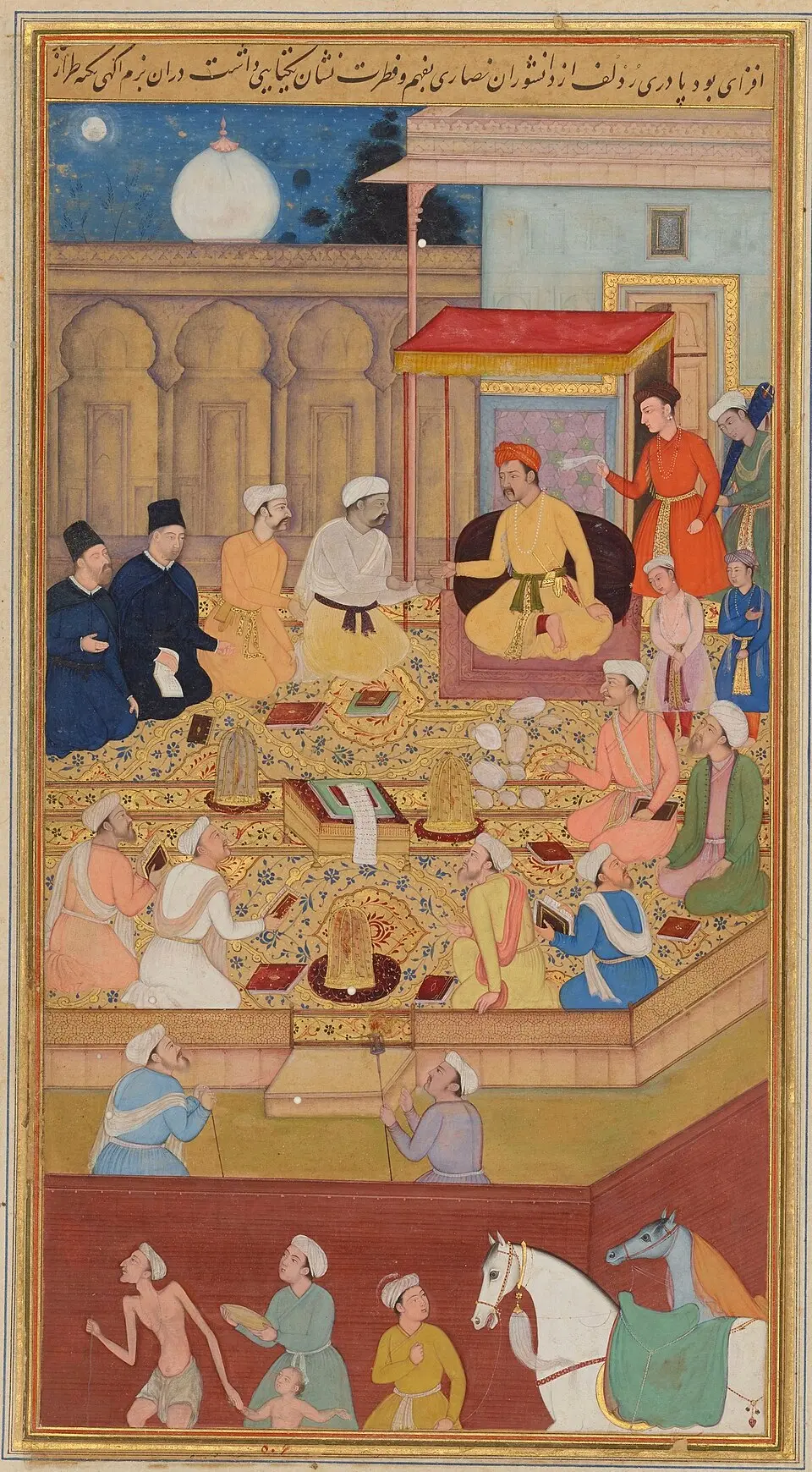
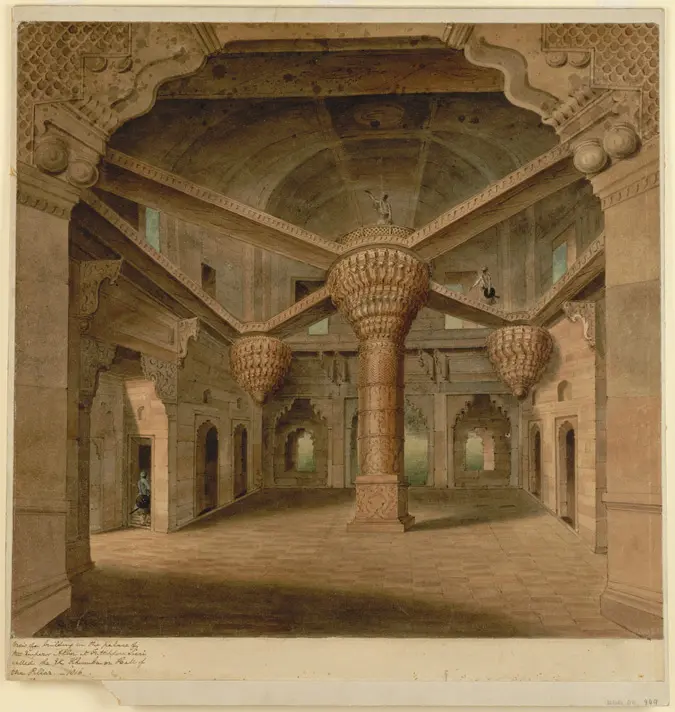
- The Ibadat Khana (1575). At Fatehpur Sikri he built a House of Worship where, at first, Sunni scholars debated. The quarrels among the ulema disappointed him, and from 1578 he opened the debates to Shias, Hindus, Jains, Zoroastrians and, from 1580, Jesuit priests from Goa.


- The Mahzar (1579). Leading ulema signed a declaration that where the jurists differed, Akbar, as a just ruler, could choose the interpretation that best served the state. This moved final authority in religious disputes from the clergy to the emperor.
- Sulh i kul (peace with all). Abul Fazl, Akbar's minister and author of the Akbarnama and Ain i Akbari, set out the idea that the ruler is above all sects and owes justice to every subject. This, not any new religion, was the core of the policy.
- Din i Ilahi (1582). Also called Tauhid i Ilahi, it was a discipleship of nobles who pledged loyalty to the emperor as a spiritual guide. It had no scripture, priests or temples, very few members, and it lapsed with Akbar's death.
- Translations. The Maktab Khana (translation bureau) rendered the Mahabharata into Persian as the Razmnama (begun 1582), and also the Ramayana, the Atharvaveda and other works, so that each community could read the other's classics.

Dimensions
- Political. Sulh i kul secured Rajput loyalty and widened the base of the empire beyond a narrow Turani and Irani nobility.
- Religious and philosophical. Akbar valued reason (aql) over blind imitation (taqlid), a stand that drew on Sufi ideas of the unity of being.
- Cultural. Indo Persian music flowered at court with Tansen; Persian absorbed Indian words; and Hindavi, which Amir Khusrau had used earlier, grew into Urdu in camps and markets and into Dakhni at Deccan courts. Bhakti and Sufi saints had already prepared this ground (see the note on Bhakti and Sufi movements).
- Artistic. Fatehpur Sikri's buildings and the illustrated Razmnama show the same synthesis in stone and paint.
In practice
Was it genuine or political?
Akbar's critics, above all the historian Abdul Qadir Badauni in his Muntakhab ut Tawarikh, accused him of abandoning Islam, and the Naqshbandi scholar Shaikh Ahmad Sirhindi later led an orthodox reaction. Modern historians such as Satish Chandra treat the policy as both conviction and statecraft: it grew from Akbar's curiosity, but it also served the needs of a ruler governing a plural empire.
Power sharing outlived the ideas
M Athar Ali's figures show that Hindus, mostly Rajputs and later Marathas, formed a larger share of the higher nobility late in Aurangzeb's reign than under Akbar. Aurangzeb reimposed jizya in 1679, so the inclusion of Hindus in the ruling class and the religious openness of the court were separate things.
Issues and way forward
- Overstating novelty. Some devices, like paper, existed in parts of India earlier; the change was in how widely they spread, which is why historians speak of diffusion rather than invention.
- Reading Akbar through one source. Abul Fazl praises and Badauni condemns; a balanced answer uses both, as Satish Chandra and Irfan Habib recommend.
- Syncretism today. India's composite culture is best kept alive through shared texts, music and festivals, which is why translation and the study of Persian archives deserve public support.
Common confusions
- Din i Ilahi and sulh i kul. Din i Ilahi was a small discipleship; sulh i kul was the whole policy of peace with all faiths.
- Mahzar and an infallibility decree. The Mahzar let Akbar choose among existing interpretations; it did not let him make new religious law against the Quran.
- Persian wheel and noria. A noria is turned by river current; the Persian wheel is geared and turned by animals at a well.
For the exam
- Keyword bank: charkha, carder's bow, saqiya, paper, lime mortar, iron stirrup, iqta, urban revolution, Ibadat Khana, Mahzar, sulh i kul, Din i Ilahi, Maktab Khana, Razmnama, Badauni.
- Previous year questions: Practise the previous year questions on this topic →
- Use in an answer:
- Introduction (data): The charkha, first clearly mentioned in the fourteenth century, multiplied a spinner's output several times, and that single device helps explain the growth of towns and cloth trade in Sultanate India.
- Introduction (judgement, quote or report): Abul Fazl described Akbar's ideal as sulh i kul, peace with all, a principle that placed the state above every sect.
- Conclusion: The Sultanate's techniques and Akbar's policy both show that medieval India changed by absorbing what came from outside and giving it an Indian form.
- Conclusion: Akbar's syncretism did not survive as a creed, but its idea of a state that treats all faiths fairly still speaks to a plural democracy.
Photo credits
Photographs are from Wikimedia Commons; each photo links to its file page, which gives the photographer and licence.