Noise, light, thermal and radioactive pollution
- Syllabus
- Conservation, environmental pollution and degradation, environmental impact assessment
- As of
- October 2026
- decibel
- A weighting
- Noise Pollution (Regulation and Control) Rules 2000
- ambient noise standards
- silence zone
- In re Noise Pollution 2005
- skyglow
- Hanle Dark Sky Reserve
- thermal pollution
- dissolved oxygen
- ionising radiation
- sievert
- half life
- Atomic Energy Regulatory Board
- SHANTI Act 2025
The first principle
Pollution is not only a matter of harmful substances; it can also be energy released in the wrong place, at the wrong time or in the wrong amount. Sound, light, heat and ionising radiation are all forms of energy, and each becomes a pollutant when its level exceeds what living things evolved to tolerate. Because energy does not pile up like a chemical, most of these pollutions stop when the source stops, which makes them easier to control at the source than most others; radioactivity is the exception, because a radioactive substance keeps emitting energy until it decays.
The core
Noise
- Sound is a pressure wave, and its loudness is measured in decibels (dB) on a logarithmic scale, so a rise of 10 dB means ten times the sound intensity and is heard as roughly twice as loud. Noise standards use the A weighted scale, dB(A), which counts frequencies the way the human ear hears them.
- Effects. Prolonged exposure to loud noise, of the order of 85 dB(A) over a working day, can damage the hair cells of the inner ear permanently, and lower levels at night disturb sleep, raise stress hormones and are linked to high blood pressure. Ship noise and sonar also disturb whales and dolphins, which navigate by sound.
- Law. Noise was added to the definition of "air pollutant" in the Air (Prevention and Control of Pollution) Act 1981 by its 1987 amendment, and the Noise Pollution (Regulation and Control) Rules 2000, framed under the Environment (Protection) Act 1986, set ambient limits by zone for day (6 am to 10 pm) and night (10 pm to 6 am).
- Silence zones are areas of at least 100 metres around hospitals, educational institutions, courts and religious places, or any area declared so. Loudspeakers and public address systems need written permission and may not be used at night except in closed premises, though a State may allow them until midnight on up to 15 festive days a year. A 2010 amendment added curbs on horns, noisy construction equipment and firecrackers at night.
Light
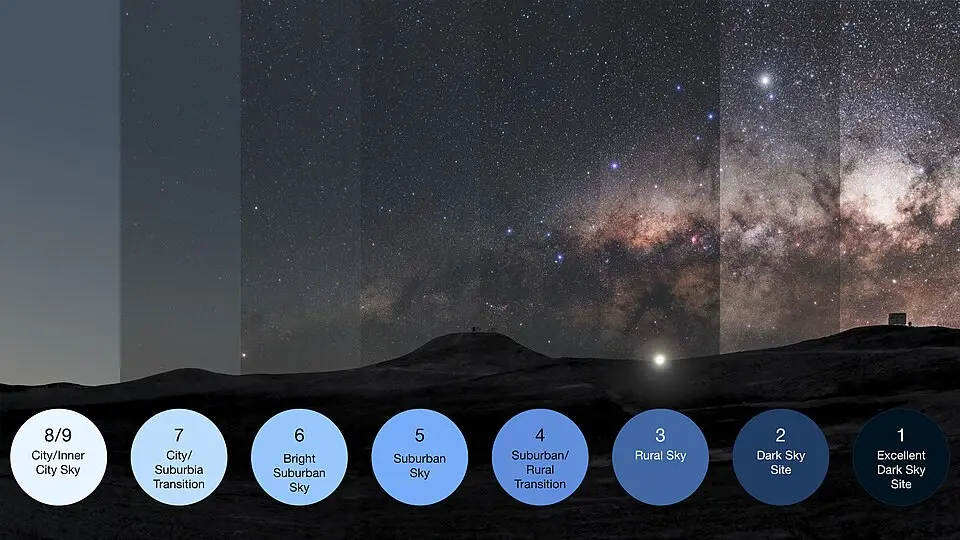
- Light pollution is excessive or misdirected artificial light at night. It takes four forms: skyglow (the brightening of the night sky over towns), glare (light that dazzles), light trespass (light spilling where it is not wanted, such as into bedrooms) and clutter (crowded, confusing groups of lights).
- The physics of skyglow. Air molecules scatter short wavelengths much more strongly than long ones (Rayleigh scattering, which varies as the inverse fourth power of wavelength), so blue rich white light from many LEDs brightens the sky more than the same amount of warm yellow light.
- Effects. Light at night suppresses melatonin, the hormone that sets the body clock, and disturbs sleep; it draws sea turtle hatchlings away from the sea, kills vast numbers of insects at lamps, causes migrating birds to collide with lit buildings, and hides the stars from astronomers. More than 80 per cent of the world's people live under light polluted skies (Falchi and others, 2016).
Thermal
- Thermal pollution is the release of heated water, mostly from the condensers of thermal and nuclear power plants that use river or sea water once and return it warmer.
- Mechanism. Warm water holds less dissolved oxygen (about 9 mg per litre at 20 °C but under 8 at 30 °C) while it raises the metabolic rate, and so the oxygen demand, of fish. The result is stress, fish kills, algal blooms and a shift to heat tolerant species; a sudden shutdown of a plant can also kill fish through thermal shock.
- Standard. Under the Environment (Protection) Rules, water discharged from once through cooling must be no more than 5 °C warmer than the intake water, and the Ministry of Environment, Forest and Climate Change (MoEFCC) norms of 2015 cap water use by thermal power plants and require cooling towers.
Radioactive
- Ionising radiation has enough energy to knock electrons out of atoms and damage DNA. Alpha particles (helium nuclei) are stopped by paper or skin but are very harmful if an emitter is inhaled or swallowed; beta particles (electrons) are stopped by a few millimetres of aluminium; gamma rays need thick lead or concrete.
- Units. Activity is measured in becquerels (one decay per second), the energy absorbed in grays (joules per kilogram) and the biological effect in sieverts, which weight the dose by the type of radiation and the tissue hit.
- Half life is the time in which half the atoms of a radioactive substance decay: about 8 days for iodine 131, about 30 years for caesium 137 and about 24,000 years for plutonium 239.
- Sources. Most of the average person's dose is natural, from radon gas, cosmic rays and rocks and soils, about 2.4 millisieverts (mSv) a year worldwide (United Nations Scientific Committee on the Effects of Atomic Radiation, UNSCEAR); the monazite sands of the Kerala coast give some of the highest natural levels in the world. Human sources are medical imaging, the nuclear fuel cycle, accidents such as Chernobyl (1986) and Fukushima (2011), and lost radioactive sources.
Dimensions
- Health. Noise and light at night disturb sleep and raise cardiovascular risk, while radiation causes two kinds of harm: deterministic effects such as radiation sickness and burns above a high threshold dose, and stochastic effects such as cancer, whose chance is taken, for radiation protection, to rise with dose without a safe threshold.
- Ecological. Light and noise change the behaviour of nocturnal and migratory animals, heat changes which species can live in a river or bay, and radioactive substances can build up in food chains.
- Urban and social. Noise from traffic, construction, festivals and loudspeakers is a constant urban grievance, and enforcement runs into religious and political sensitivity.
- Legal and constitutional. The Supreme Court has read the right to a peaceful environment, including sleep, into the right to life under Article 21, which makes noise control a matter of fundamental rights.
In practice
- Ambient noise monitoring. The Central Pollution Control Board (CPCB) has run a real time ambient noise monitoring network in major cities since 2011, and its readings often exceed the limits for residential and silence zones, especially at night and during festivals.
- Church of God (Full Gospel) in India v K K R Majestic Colony Welfare Association (2000). The Supreme Court held that no religion requires prayers to be performed by disturbing the peace of others through loudspeakers or drums.
- In re Noise Pollution (2005). The Supreme Court held that freedom from noise is part of the right to life under Article 21, banned loudspeakers between 10 pm and 6 am except in emergencies, and barred the bursting of firecrackers in the same hours.
- Hanle Dark Sky Reserve. India's first dark sky reserve, around the Indian Astronomical Observatory at Hanle in Ladakh, controls outdoor lighting in surrounding villages to protect the night sky for astronomy and astro tourism.
- The radiation regulator. The Atomic Energy Regulatory Board (AERB), set up in 1983 under the Atomic Energy Act 1962, sets and enforces radiation safety standards, including a public dose limit of 1 mSv a year from human made sources and an occupational limit of 20 mSv a year averaged over five years. The SHANTI (Sustainable Harnessing and Advancement of Nuclear Energy for Transforming India) Act 2025 replaced the 1962 Act and the Civil Liability for Nuclear Damage Act 2010 and gave the AERB statutory status, with every activity involving radiation exposure needing its safety authorisation.
- Mayapuri, Delhi (2010). A cobalt 60 source from a disused laboratory irradiator was sold as scrap, and one scrap worker died of radiation exposure, which exposed the weak tracking of radioactive sources at the end of their life.
- Nuclear waste. India reprocesses spent fuel to recover plutonium and immobilises high level waste in glass; reactor safety, waste and the liability law are covered in the S&T note on nuclear power, and uranium in groundwater in the water pollution note.

Issues and way forward
- Weak enforcement of noise rules. Police and pollution control boards rarely measure noise or act on complaints, so real time monitoring linked to enforcement, noise maps for cities, and penalties for repeat violators are needed.
- No law on light pollution. India has no national standard for outdoor lighting, so shielded fixtures that point light downward, warmer colour temperatures and switching off unneeded lights near turtle nesting beaches and protected areas should be written into building codes and smart city plans.
- Cooling water in a warming climate. Hotter rivers make thermal discharge worse, so dry cooling and the use of treated sewage water in power plants deserve wider adoption.
- Orphan radioactive sources. Lost or discarded sources in hospitals, industry and scrap trade remain a hazard, so cradle to grave tracking and radiation detectors at scrap yards and ports are needed.
- Public trust in nuclear safety. Opposition to plants such as Kudankulam rests partly on fear of radiation, so an independent, transparent regulator that publishes its findings is essential as private companies enter the sector.
Common confusions
- Decibel and dB(A). The decibel is a logarithmic unit of sound level, while dB(A) is a decibel reading weighted for the frequencies the human ear hears best, and Indian standards are in dB(A).
- Gray and sievert. The gray measures the energy absorbed per kilogram, while the sievert measures the biological effect of that dose after weighting for radiation type and tissue.
- Radioactivity and radiation. Radioactivity is the property of unstable nuclei that decay, while radiation is the energy they emit; a person exposed to gamma rays does not become radioactive, but one who swallows a radioactive substance carries a source inside.
- Deterministic and stochastic effects. Deterministic effects appear above a threshold dose and worsen with dose, while for stochastic effects such as cancer only the probability rises with dose, and radiation protection assumes no safe threshold.
For the exam
- Keyword bank: decibel, dB(A), Noise Pollution (Regulation and Control) Rules 2000, silence zone, Article 21 and right to sleep, skyglow, Rayleigh scattering, dark sky reserve, thermal pollution, dissolved oxygen, ionising radiation, half life, sievert, Atomic Energy Regulatory Board, SHANTI Act 2025.
- Previous year questions: Practise the previous year questions on this topic →
- Use in an answer:
- Introduction with data: More than 80 per cent of the world's people live under light polluted skies (Falchi and others, 2016), while India's noise rules allow only 45 dB(A) at night in residential areas and 40 dB(A) in silence zones.
- Introduction with a judgement: In In re Noise Pollution (2005) the Supreme Court held that freedom from noise is part of the right to life under Article 21 and barred loudspeakers and firecrackers between 10 pm and 6 am.
- Conclusion: Noise, light and heat are pollutions of energy that stop when the source stops, so better design and steady enforcement can control them far more cheaply than the damage they cause.
- Conclusion: As India expands nuclear power with private participation, an independent and transparent radiation regulator is the condition for public trust.