Populations, communities and succession
- Syllabus
- Conservation, environmental pollution and degradation, environmental impact assessment
- As of
- October 2026
- population growth
- carrying capacity
- r and K selection
- ecological niche
- competitive exclusion
- species interactions
- keystone species
- umbrella species
- flagship species
- indicator species
- ecotone
- edge effect
- ecological succession
- climax community
- invasive alien species
The first principle
No population can grow for ever, because every habitat has limits of food, space and shelter, and every species shares those limits with others. Ecology at this level is therefore about two kinds of pressure: the pressure a population puts on its own resources, which sets how large it can grow, and the pressure species put on one another, which sets who lives where. Communities are not fixed, either: on a bare rock or an abandoned field they change in a predictable order until they reach a stable state, and conservation works best when it follows that order rather than fights it.
The core
Populations
- What a population is. A population is a group of individuals of one species living in an area at the same time, and it has properties an individual lacks: density, birth rate (natality), death rate (mortality), sex ratio and age structure. Its size changes through four processes, so that the population at the next count equals the present population plus births and immigrants minus deaths and emigrants.
- Exponential growth. With unlimited resources a population grows at a rate proportional to its size, so that the rate of change of population N with time equals rN, where r is the intrinsic rate of natural increase. Plotted against time this gives a J shaped curve, typical of a pest outbreak, which ends in a crash.
- Logistic growth. Real habitats have a carrying capacity, K, the largest population they can support, so growth slows as the population approaches it. The logistic equation multiplies rN by the fraction of capacity still unused, (1 − N/K), which gives an S shaped curve that levels off at K.
- Two strategies. Species that live in unstable habitats tend to be r selected, producing many small offspring with little care, as insects and weeds do, while species in stable, crowded habitats tend to be K selected, producing few large offspring with long care, as elephants and great apes do. K selected species recover slowly from losses, which makes large mammals vulnerable.
Communities and the niche
- The niche. A habitat is where a species lives, while its niche is its whole role: what it eats, when it is active and what conditions it tolerates. G E Hutchinson described the niche in 1957 as a space with many dimensions, one for each factor, and distinguished the fundamental niche a species could occupy alone from the narrower realised niche it actually holds when competitors are present.
- Competitive exclusion. G F Gause showed in the 1930s, with two species of Paramecium, that two species competing for the same limiting resource cannot coexist indefinitely, because one will exclude the other. Species that do share a habitat usually divide it, as Robert MacArthur showed for five warbler species that feed in different parts of the same trees, which is called resource partitioning.
- Species interactions. Interactions are scored by their effect on each partner: in mutualism both gain, in competition both lose, in predation and parasitism one gains at the other's cost, in commensalism one gains while the other is unaffected, and in amensalism one is harmed while the other is unaffected. Predators also keep prey from overrunning a habitat: the prickly pear cactus spread across millions of hectares of Australia until a moth that feeds on it was brought in from its native range.
Ecological succession
- The sequence. Succession is the gradual, predictable change in the species of a community over time, through a series of seral stages called a sere, until a relatively stable climax community is reached that is in balance with the local climate and soil.
- Primary and secondary. Primary succession begins where there is no soil, on bare rock, lava or a new sandbank, and takes centuries, because soil must be built first. Secondary succession begins where a community has been removed but soil remains, as on an abandoned field or after a fire, and is far faster.
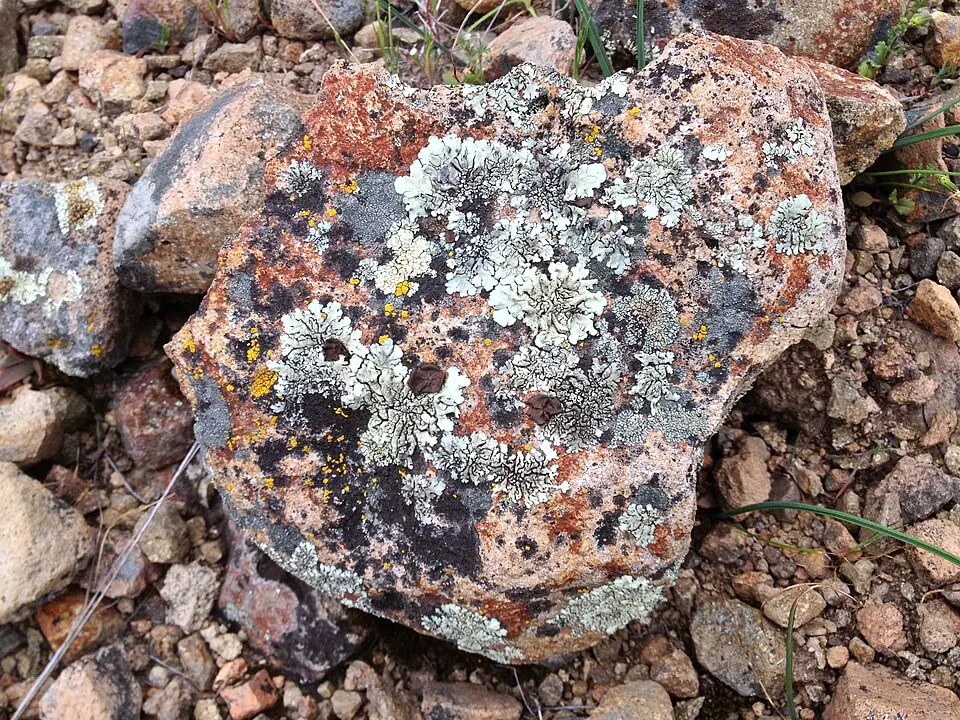
- Two directions. On rock (xerarch succession) lichens are the pioneers: they secrete acids that dissolve rock and begin soil, followed by mosses, herbs, shrubs and trees. In water (hydrarch succession) phytoplankton are followed by submerged, then floating plants, reed swamp, marsh and finally forest, so both series move towards medium, or mesic, conditions.

Dimensions
- Keystone species. A keystone species has an effect far larger than its numbers would suggest. Robert Paine, who coined the term in 1969, removed the predatory starfish Pisaster from a stretch of the Pacific shore of North America and found that the number of species on it fell from fifteen to eight, as mussels and barnacles, no longer eaten, crowded out the rest. In India the Asian elephant, Elephas maximus (Endangered on the International Union for Conservation of Nature (IUCN) Red List, Schedule I of the Wildlife (Protection) Act 1972 as amended in 2022, and Appendix I of the Convention on International Trade in Endangered Species of Wild Fauna and Flora (CITES)), opens forest and disperses seeds, and fig trees feed animals when little else is fruiting.
- Umbrella and flagship species. An umbrella species needs so large an area that protecting it protects everything within it, as the tiger, Panthera tigris (IUCN Endangered, Schedule I, CITES Appendix I), does in its reserves. A flagship species is chosen for public appeal to win support, as with the tiger and the Gangetic river dolphin, Platanista gangetica (IUCN Endangered, Schedule I, CITES Appendix I), declared India's national aquatic animal in 2009.
- Indicator and foundation species. Indicator species reveal the state of a habitat because they are sensitive to change, as lichens are to sulphur dioxide in the air and frogs and mayflies are to water quality. Foundation species build the habitat that others live in, as corals and mangroves do.
- Ecotone and edge effect. An ecotone is a transition zone between two communities, such as a mangrove between land and sea or the margin between forest and grassland, and it often holds more species than either side, which is called the edge effect. Fragmentation, however, multiplies edges inside a forest, which helps edge species such as weeds and crows but harms interior species that need deep, undisturbed cover.
In practice
- Invasive species break the rules of competition. An alien species freed from its natural enemies can outcompete natives, as Gause's principle predicts. Lantana camara, brought to India as an ornamental in the colonial period, now forms dense thickets in many forests, and Prosopis juliflora, planted in the Banni grasslands of Kachchh in the 1960s to check desertification, has replaced much of the native grassland on which pastoral communities depend.
- The law on invasives. The Wildlife (Protection) Amendment Act 2022 empowered the Central government to regulate or prohibit the import, trade, possession or spread of invasive alien species. Target 6 of the Kunming–Montreal Global Biodiversity Framework of 2022 asks countries to cut the introduction and establishment of invasive species by at least half by 2030.
- Succession in shifting cultivation. In jhum, the shifting cultivation of north eastern India, a forest patch is cleared, farmed for a year or two and then left to regrow by secondary succession. Where the fallow period has shortened from a few decades to a few years, the forest cannot recover and the soil degrades.
- Managing succession on purpose. Grasslands in many protected areas, such as the floodplain grasslands of Kaziranga, are seral stages that would turn into woodland if left alone, so managers use controlled burning to hold them at the stage on which the greater one horned rhinoceros, Rhinoceros unicornis, and the swamp deer, Rucervus duvaucelii (both IUCN Vulnerable, Schedule I, CITES Appendix I), feed.
Issues and way forward
- Conservation spends on flagships. Money follows charismatic species, while keystone species such as pollinators, fig trees and scavengers receive little, so planning at the scale of landscapes and functions, not only of single species, gives better value.
- Invasives spread faster than they are removed. Clearing Lantana or Prosopis is expensive and they regrow, so early detection at entry points, a national list of invasive species with clear rules, and restoration with native species after removal are needed together.
- Fragmentation multiplies edges. Roads, canals and farms cut forests into small patches dominated by edge effects, which pushes out interior species; wildlife corridors and underpasses on linear projects restore connectivity.
- Restoration ignores succession. Planting a single fast growing tree species on a degraded site skips the stages that build soil and diversity, so restoration should follow natural succession, use local species and protect natural regeneration wherever it is possible.
Common confusions
- Habitat and niche. The habitat is the address of a species, while the niche is its profession: what it does, eats and needs there.
- Keystone and umbrella species. A keystone species matters because of what it does in the ecosystem, while an umbrella species matters because of how much space it needs; the tiger is a clear umbrella, and its keystone role depends on the prey it controls.
- Primary and secondary succession. Primary succession starts without soil and takes centuries, while secondary succession starts with soil already present and takes decades.
- Ecotone and edge effect. The ecotone is the transition zone itself, while the edge effect is the tendency of that zone to hold more species and individuals than the communities on either side.
For the exam
- Keyword bank: carrying capacity, exponential and logistic growth, r and K selection, fundamental and realised niche, competitive exclusion, resource partitioning, mutualism, keystone species, umbrella and flagship species, indicator species, ecotone, edge effect, ecological succession, pioneer species, climax community.
- Previous year questions: Practise the previous year questions on this topic →
- Use in an answer:
- Introduction with data: When Robert Paine removed one predator, the starfish Pisaster, from a stretch of shore, the number of species there fell from fifteen to eight, which showed how one keystone species holds a community together.
- Introduction with a law: The Wildlife (Protection) Amendment Act 2022 gave the Central government power to regulate invasive alien species, recognising that a single introduced plant or animal can reshape a whole community.
- Conclusion: Communities are held together by interactions, so conservation that protects keystone links, connected habitats and natural succession protects far more than the species it names.
- Conclusion: Working with succession, by letting degraded land regenerate in stages with native species, is cheaper and more durable than planting a single species and hoping for a forest.