Sources of ancient and medieval history
- Syllabus
- Indian culture will cover the salient aspects of Art Forms, Literature and Architecture from ancient to modern times.
- As of
- October 2026
- epigraphy
- numismatics
- Ashokan edicts
- Brahmi
- James Prinsep
- dhamma
- dhamma mahamattas
- Rock Edict XIII
- prashasti
- Allahabad pillar
- Hathigumpha
- Faxian
- Xuanzang
- Al Biruni
- Ibn Battuta
The first principle
Every historical source tells us what its author wanted, saw or could understand, so history is rebuilt by setting sources against each other rather than trusting any one. Inscriptions give a ruler's own claims, dated and fixed in place; literature gives ideals and memory; coins and archaeology show what people actually made and used; and foreign travellers give an outsider's eye that notices what locals took for granted. Ancient India left few chronicles, so its history depends more than most on inscriptions and on the accounts of visitors, and the value of each lies in what it adds to the others.
The core
Types of sources
- Literary sources. Religious texts (Vedas, epics, Puranas, Tripitaka, Jain Agamas) describe beliefs but are hard to date; secular works such as the Arthashastra, Sangam poems and Kalhana's Rajatarangini (twelfth century) give political detail.
- Epigraphy. Inscriptions on rock, pillars and copper plates are the most reliable dated evidence, from royal edicts and prashastis (eulogies) to land grants that reveal agrarian change.
- Numismatics. Coins name rulers, show their gods and titles, and through their metal and find spots reveal trade and economic health, as Roman gold in south India and debased late Gupta coins show.
- Archaeology and foreign accounts. Excavation reaches people that texts ignore, while Greek, Chinese, Arab and European visitors describe what they saw, often with dates that fix Indian chronology.
The Ashokan inscriptions
Ashoka (about 268 to 232 BCE) was the first Indian ruler to speak directly to his subjects in writing, and his inscriptions are the backbone of Mauryan history.
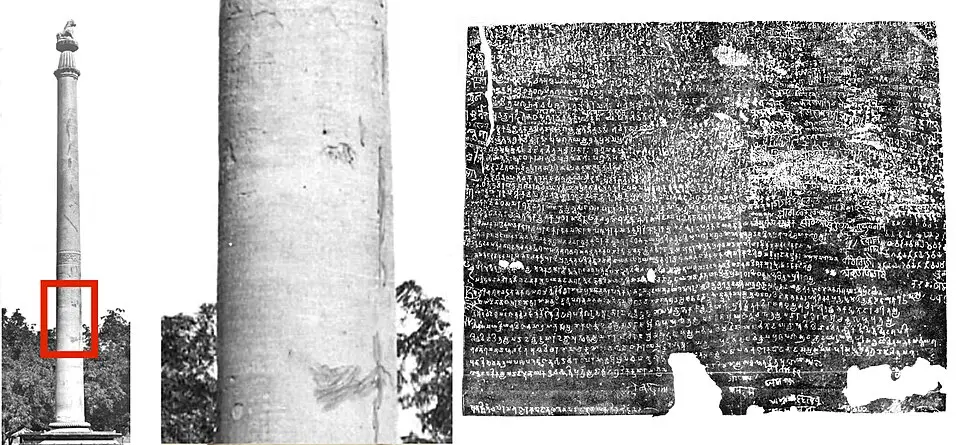
- Types. There are fourteen Major Rock Edicts, found at sites such as Girnar, Kalsi, Shahbazgarhi, Mansehra, Dhauli and Jaugada; Minor Rock Edicts, such as Maski, Brahmagiri and Bairat; seven Pillar Edicts, all seven together only on the Delhi Topra pillar; minor pillar inscriptions, such as Rummindei and Sanchi; and two Separate Rock Edicts at Dhauli and Jaugada in Kalinga.
- Scripts and language. Most are in Prakrit in the Brahmi script; those in the northwest (Shahbazgarhi and Mansehra) use Kharosthi, and the Kandahar inscriptions in Afghanistan are in Greek and Aramaic, so Ashoka addressed each region in the script it could read.
- Decipherment. James Prinsep deciphered Brahmi in 1837, but the king called Devanampiya Piyadasi (beloved of the gods, of pleasing appearance) was firmly identified as Ashoka only when the Maski edict, found in 1915, gave his name.
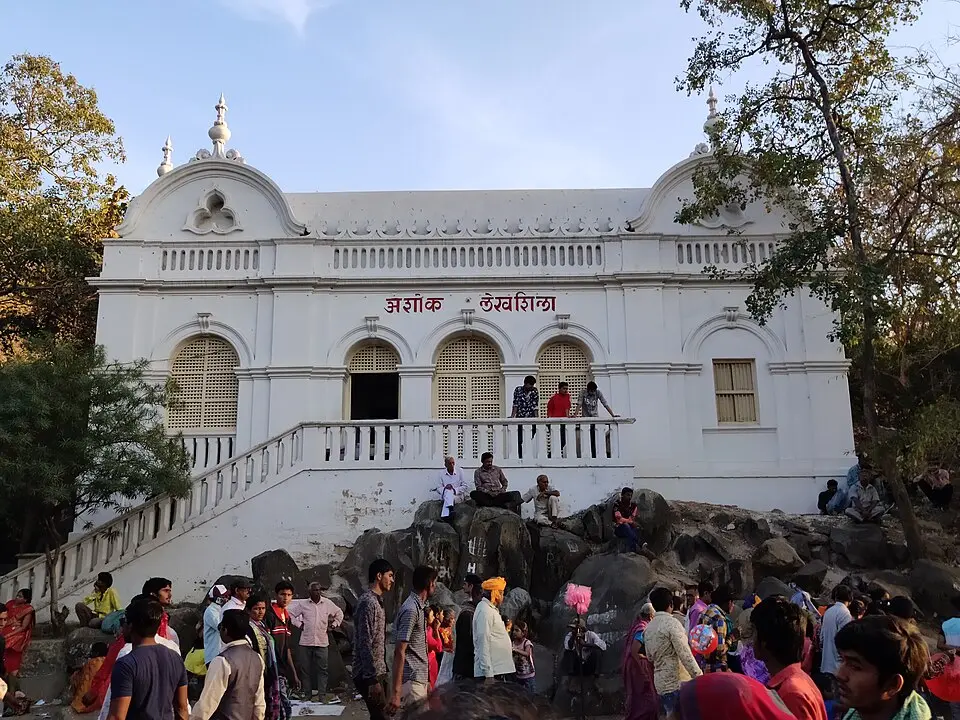

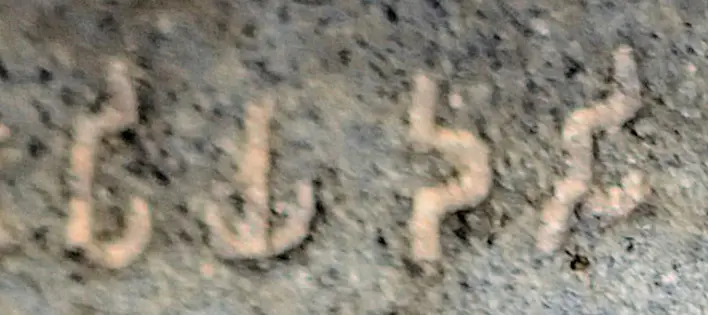

What the Ashokan inscriptions tell us about Mauryan history
- Extent of the empire. Find spots from Kandahar in the northwest to Brahmagiri and Maski in Karnataka, Girnar in the west and Dhauli in the east map the empire better than any text. Rock Edict II names the Cholas, Pandyas, Satiyaputras, Keralaputras and Tamraparni (Sri Lanka) as neighbours, which shows the far south lay outside it.
- The Kalinga war. Rock Edict XIII records that 150,000 people were deported, 100,000 killed and many more died, and expresses the king's remorse, which marks the turn from conquest by arms to conquest by dhamma.
- Dhamma. The edicts define dhamma as respect for elders, kindness to slaves and servants, generosity to Brahmins and shramanas, restraint in speech and tolerance of all sects (Rock Edict XII). Romila Thapar argues it was a moral policy to hold a diverse empire together rather than Buddhist preaching alone, while edicts such as Bairat show his personal Buddhism.
- Administration. Dhamma mahamattas were appointed in the thirteenth year after his coronation (Rock Edict V); rajukas, yuktas and pradeshikas toured every five years (Rock Edict III); rajukas received judicial powers (Pillar Edict IV); and the Separate Rock Edicts tell Kalinga officials that all men are the king's children.
- Welfare. Rock Edict II records medical care for people and animals, wells and trees along roads, and Rock Edict I restricts animal sacrifice; the Rummindei inscription reduces the tax of Lumbini, the Buddha's birthplace, to one eighth.
- Foreign relations. Rock Edict XIII names five Hellenistic kings, including Antiochus II of Syria and Ptolemy II of Egypt, to whom dhamma envoys were sent; these names also help date Ashoka's reign.
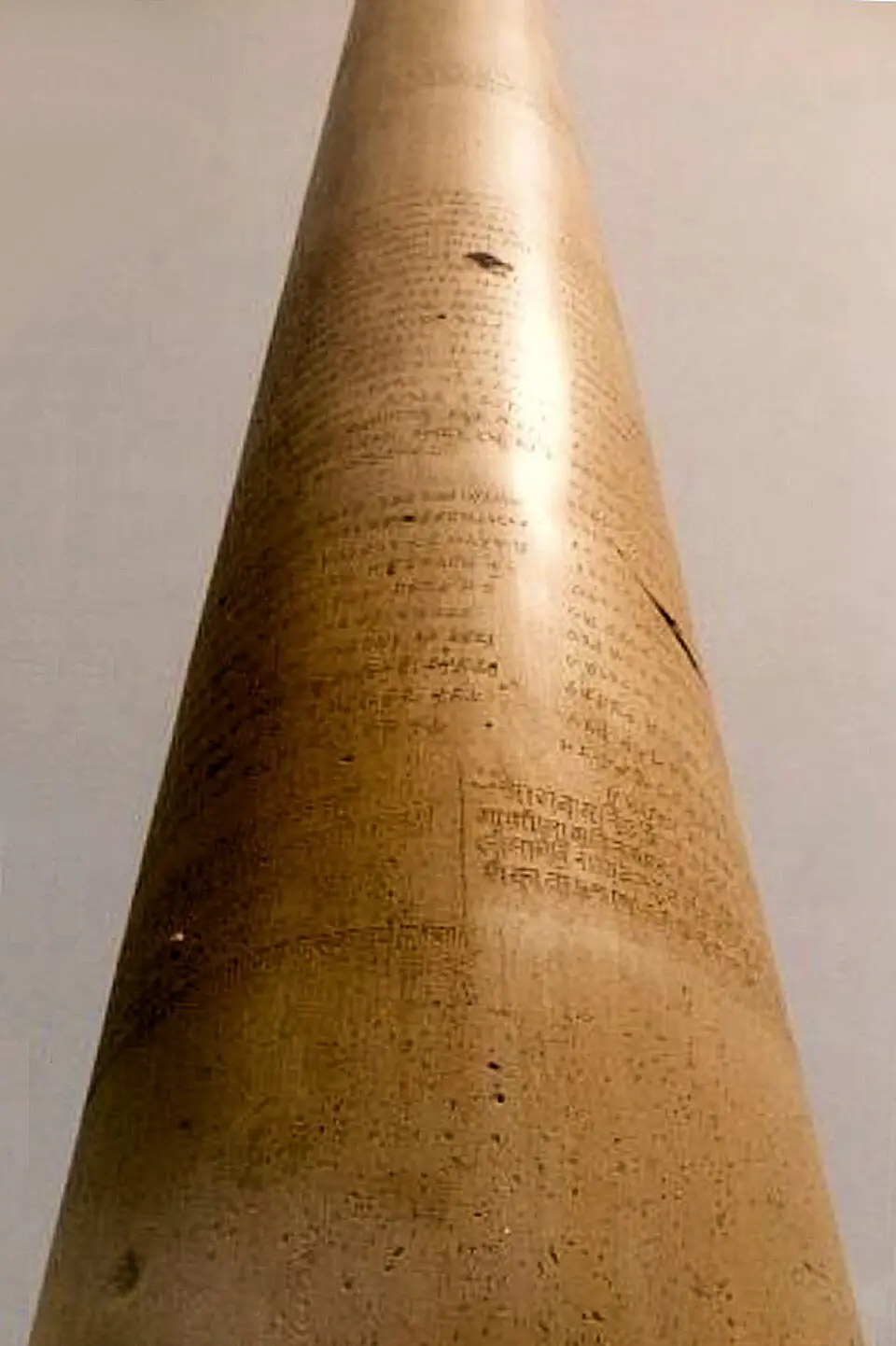

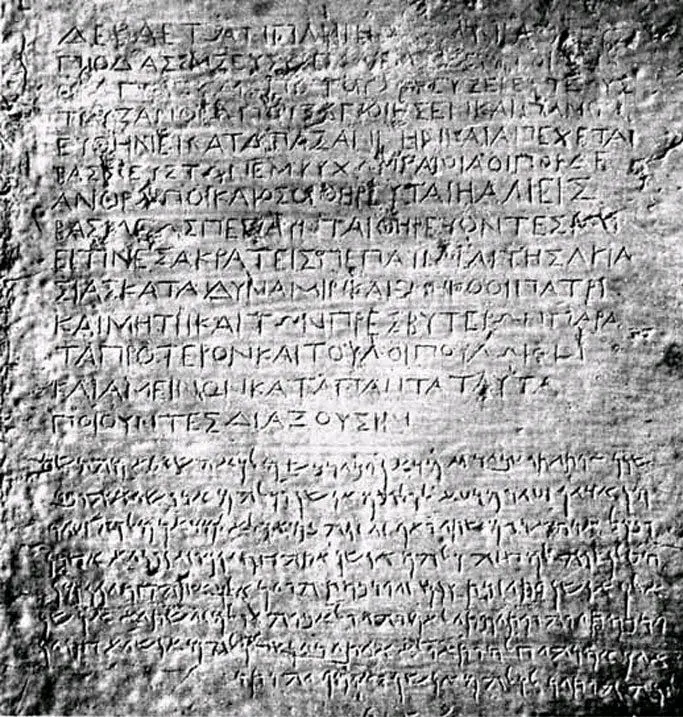

Limits of the Ashokan inscriptions
As royal statements they present the king as he wished to be seen, and they say little about revenue, the army or the economy, which must come from the Arthashastra and Megasthenes. The remorse of Rock Edict XIII was left out of the edicts set up in Kalinga itself, which suggests the message was tailored to the audience.
Other key inscriptions
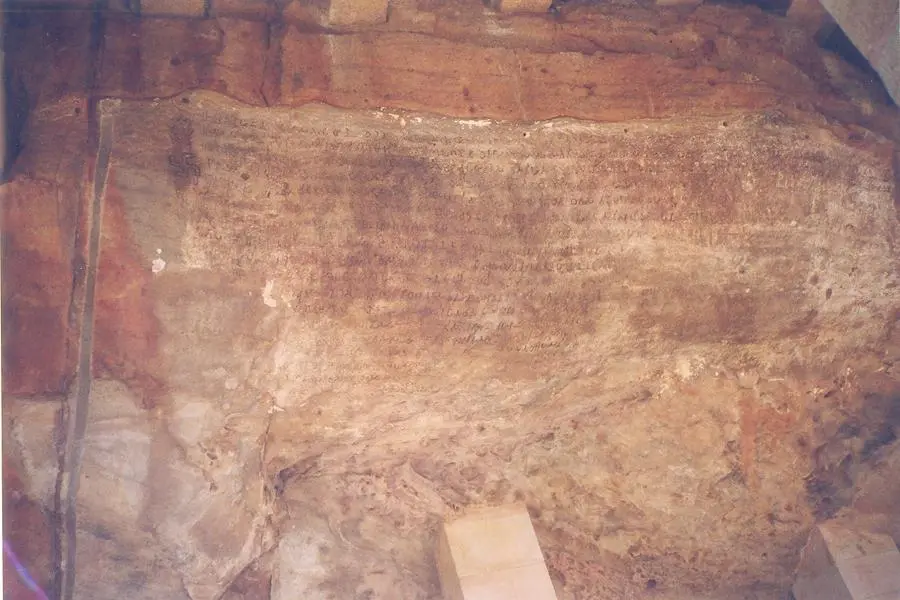
- Hathigumpha inscription of Kharavela of Kalinga (about the first century BCE), at Udayagiri near Bhubaneswar, gives a year by year account of his reign in Prakrit, opens with a Jain invocation and mentions a canal dug by a Nanda king.
- Junagadh rock inscription of Rudradaman (150 CE), the first long inscription in chaste Sanskrit, records the repair of the Sudarshana lake, first built under Chandragupta Maurya, which confirms Mauryan rule in Saurashtra.
- Allahabad prashasti of Samudragupta, composed by the court poet Harishena and engraved on an Ashokan pillar, lists his conquests and his policy of capturing and then reinstating southern kings.
- Aihole inscription (634 CE) of Pulakeshin II, composed by the Jain poet Ravikirti, records his victory over Harsha and names Kalidasa, which helps date the poet.
- Uttaramerur inscriptions of the Chola king Parantaka I (tenth century) describe how village assemblies chose members by lot (kudavolai) and the qualifications they set.


Dimensions
- Political. Inscriptions and coins give rulers, dates and boundaries, the skeleton on which political history hangs.
- Social. Travellers and land grants show caste, the position of women and untouchability, as Faxian's note on Chandalas living outside towns shows.
- Religious. Chinese pilgrims record monasteries, sects and pilgrim sites, many later found by excavation.
- Economic. Coins, hoards and Arab merchants' accounts trace trade routes and money.
In practice
The value of Chinese and Arab travellers' accounts
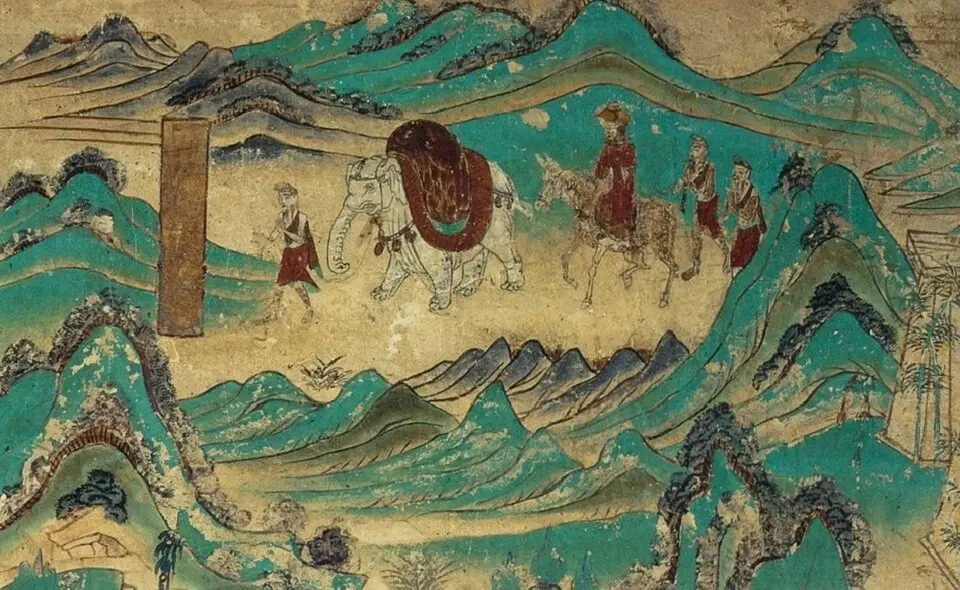
- Faxian (about 399 to 412 CE) came in search of Buddhist texts during the reign of Chandragupta II. He described a peaceful land with mild punishments and free hospitals at Pataliputra, and recorded that Chandalas lived outside towns, though he never named the king.
- Xuanzang (629 to 645) studied at Nalanda under Shilabhadra. His Si yu ki (Records of the Western Regions) describes Harsha's assemblies at Kannauj and Prayag, Nalanda's curriculum and Pulakeshin II's strength, and his precise routes guided archaeologists such as Alexander Cunningham to Buddhist sites.
- Yijing (in India 673 to 685) spent about ten years at Nalanda and travelled by sea through Srivijaya, recording monastic rules and the maritime link with Southeast Asia.
- Sulaiman (851), an Arab merchant, described the Pala, Pratihara and Rashtrakuta kingdoms and ranked the Rashtrakuta king among the great rulers of the world, while Al Masudi (visited about 915) described the Rashtrakutas and Pratiharas.
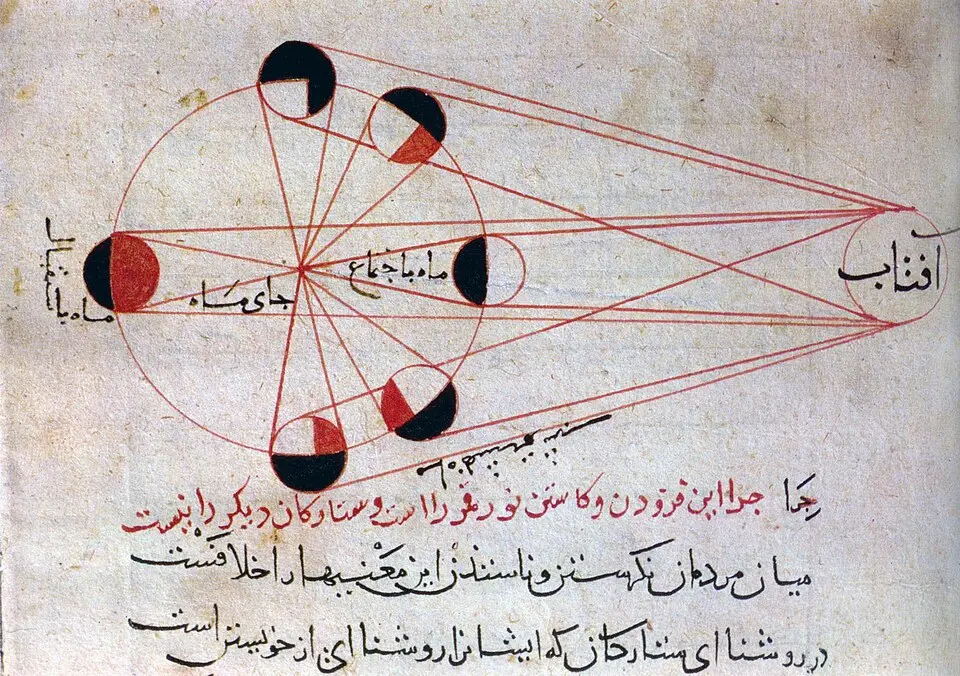
- Al Biruni came with Mahmud of Ghazni, learnt Sanskrit and wrote Kitab ul Hind (about 1030) on Indian religion, philosophy, caste, astronomy and festivals. He noted the language barrier, the difference of religion and Indian reluctance to share knowledge with outsiders, and relied heavily on Brahmanical texts.
- Ibn Battuta, a Moroccan, reached India in 1333 and served as qazi of Delhi under Muhammad bin Tughlaq; his Rihla describes the postal system, cities, markets and slavery. Marco Polo (1292) described the Pandya coast, and Abdur Razzaq (1443), envoy of the Timurid ruler Shah Rukh, described Calicut and Vijayanagara under Deva Raya II.


Their limits
The Chinese pilgrims saw India through Buddhist eyes, so they dwelt on miracles and said little about Brahmanical or common life. The Arab writers faced the language barrier, relied on informants and often generalised from one region, and Ibn Battuta dictated his account from memory years later.
Coins and archaeology, briefly
Punch marked coins of the Mauryan period, Indo Greek coins with royal portraits, Kushana and Gupta gold coins, and Satavahana coins with ships each date rulers and show trade. Excavations at sites such as Arikamedu (Roman trade) and Nalanda confirm what texts and travellers said.
Issues and way forward
- Damage to inscriptions. Weathering, graffiti and quarrying erode rock edicts; shelters, digital estampages and three dimensional scans by the Archaeological Survey of India (ASI) preserve them.
- Unpublished material. Thousands of inscriptions and copper plates remain unread because few epigraphists know old scripts; the ASI's epigraphy branch and university courses in Brahmi and Grantha need expansion.
- Theft and illegal trade. Coins, sculptures and manuscripts leave India illegally; the Antiquities and Art Treasures Act, 1972 and repatriation efforts need stronger enforcement.
Common confusions
- Major and Minor Rock Edicts. The fourteen Major Rock Edicts set out dhamma and policy; the Minor Rock Edicts are shorter, more personal and include those that name Ashoka, such as Maski.
- Faxian and Xuanzang. Faxian came under Chandragupta II (Gupta age); Xuanzang came under Harsha, two centuries later.
- Prashasti and edict. An edict is the king's own order; a prashasti is a poet's eulogy of the king.
- Al Biruni and Ibn Battuta. Al Biruni (eleventh century) was a scholar studying Indian texts; Ibn Battuta (fourteenth century) was a traveller and official describing what he saw.
For the exam
- Keyword bank: epigraphy, numismatics, Brahmi, Kharosthi, Prinsep 1837, Maski edict, Devanampiya Piyadasi, Rock Edict XIII, dhamma mahamatta, rajuka, prashasti, Si yu ki, Kitab ul Hind, Rihla.
- Previous year questions: Practise the previous year questions on this topic →
- Use in an answer:
- Introduction (data): Ashoka's fourteen Major Rock Edicts and seven Pillar Edicts, written in four scripts from Kandahar to Odisha, form the first large body of royal writing in Indian history.
- Introduction (judgement, quote or report): Al Biruni himself admitted that language and religious difference made India hard for an outsider to understand, which captures both the value and the limits of foreign accounts.
- Conclusion: Ashokan inscriptions give Mauryan history its dates, map and moral voice, but they must be read alongside the Arthashastra, Megasthenes and archaeology.
- Conclusion: Chinese and Arab travellers fill the gaps of a land with few chronicles, and their worth grows when tested against inscriptions and coins.
Photo credits
Photographs are from Wikimedia Commons; each photo links to its file page, which gives the photographer and licence.