Temple sculpture and bronzes
- Syllabus
- Indian culture will cover the salient aspects of Art Forms, Literature and Architecture from ancient to modern times.
- As of
- October 2026
- surasundari
- apsara
- mithuna
- tribhanga
- high relief
- Chandella sculpture
- Khajuraho
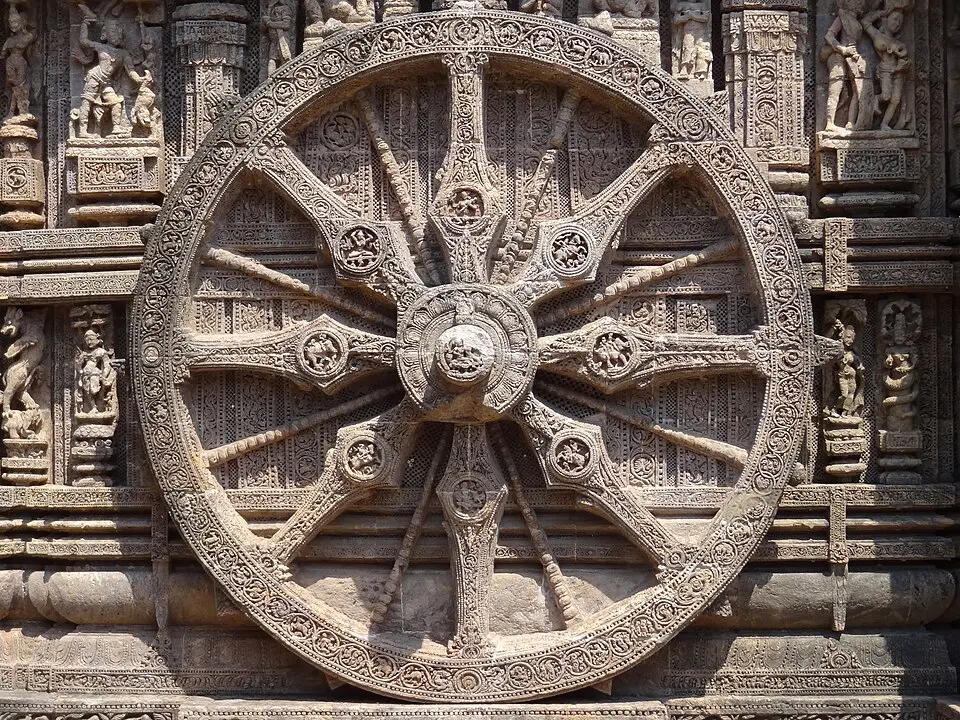
- Konark
- Hazara Rama reliefs
- madanika
- Hoysala soapstone
- lost wax
- Chola bronzes
- Nataraja
- Somaskanda
The first principle
Sculpture on a medieval temple is not ornament added to a building; it is how the temple teaches. The outer walls show the whole visible world, gods, lovers, kings, soldiers, dancers and animals, while the sanctum holds a single image in darkness, so the devotee passes from the many to the one. Because sculptors took their models from the life around them, those walls also record how people dressed, fought, danced, traded and loved. Bronzes answer a different need: a stone image cannot leave the sanctum, so a metal image light enough to carry in festival processions was made, and that is why the bronze flourished alongside the great temple festivals of the south.
The core
How temple sculpture shows the social life of its time
- Kings and courts. At Konark the king, usually identified as Narasimhadeva I, appears in court and at worship, and Hoysala friezes show royal processions, so sculpture records how rulers wanted to be seen.
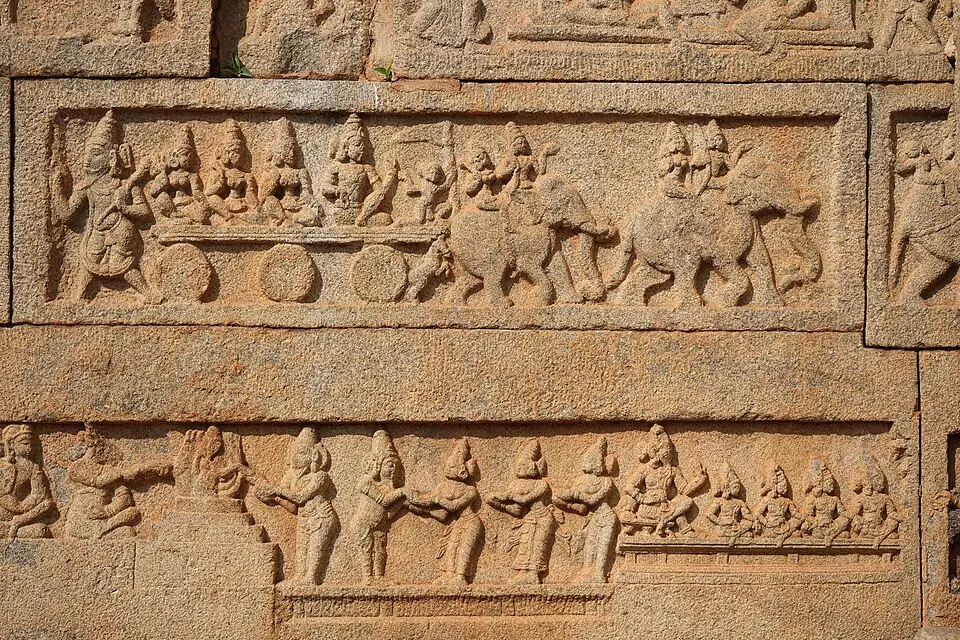
- War and hunting. The platform frieze of the Lakshmana temple at Khajuraho shows marching armies, elephants, horsemen and hunters, and the outer walls of the Hazara Rama temple at Hampi (fifteenth century, Vijayanagara) carry bands of soldiers, horses and elephants.
- Music and dance. Women musicians with drums, cymbals and flutes line the terraces of the Konark hall, and the dance poses (karanas) of the Natya Shastra are carved at Chidambaram and Thanjavur, showing that classical dance had a codified grammar by then.
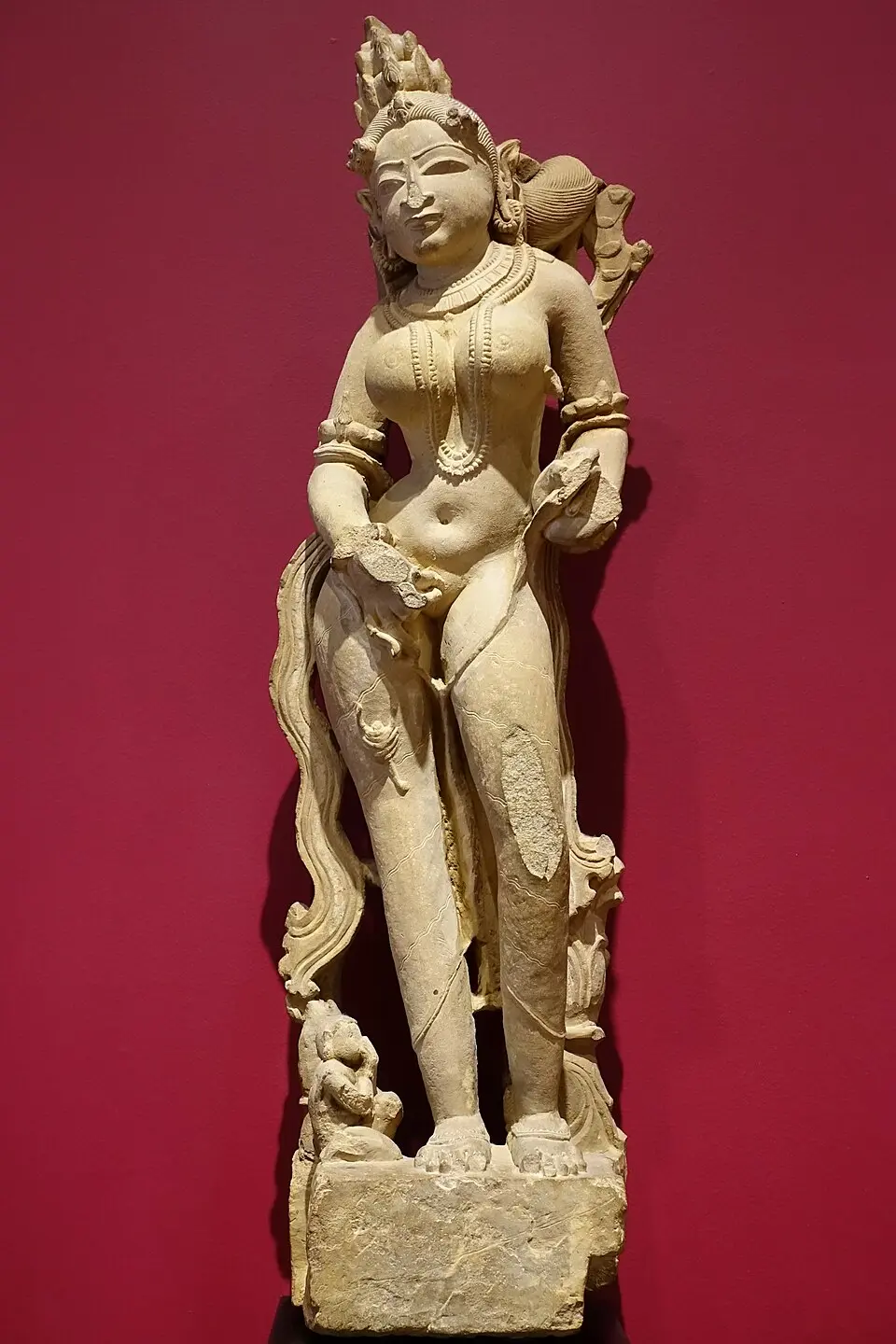
- Women's daily lives. Khajuraho's surasundaris apply kohl, write letters, look into mirrors, wring water from their hair and pull a thorn from a foot, which tells us about dress, jewellery, cosmetics and literacy among elite women.
- Trade and foreigners. Hampi's reliefs show horses led by foreign grooms, a reminder that Vijayanagara imported war horses by sea, and a giraffe carved at Konark is often read as a sign of contact with Africa through Arab traders.
- Festivals and faith. The Hazara Rama processions are usually taken to show the Mahanavami festival that foreign travellers described, while teachers with pupils and ascetics appear across Khajuraho and Hoysala walls.
- Love and desire. Mithunas (loving couples) and erotic scenes appear at Khajuraho and Konark. Scholars read them in several ways: as kama, one of the four legitimate aims of life; as auspicious symbols of fertility that protect the building; as signs of Tantric ideas current at the time; or as an allegory of the soul's union with the divine. They form a small share of the carving and are kept to the outer walls.
- Limits. Sculpture idealises and shows mainly courts, gods and the wealthy; peasants and labourers appear rarely. It must therefore be read alongside inscriptions and texts such as the Manasollasa of the Chalukya king Someshvara III, which describes royal pastimes.


Chandella sculpture at Khajuraho: vigour and breadth of life
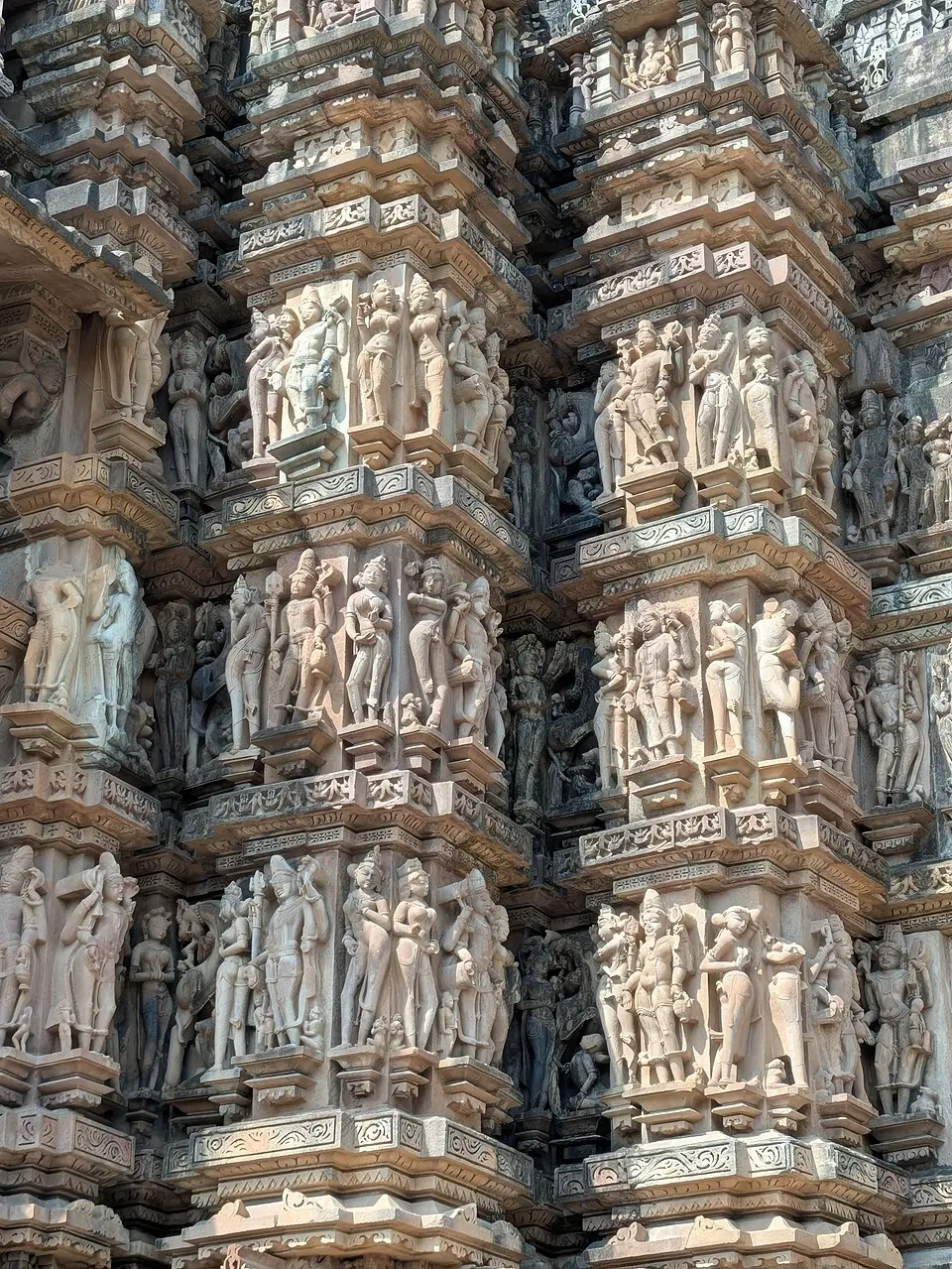
- The Chandellas of Bundelkhand built most of the Khajuraho temples between about 950 and 1050 CE (Common Era) in a fine grained sandstone that takes deep, crisp cutting. On the walls of temples such as the Kandariya Mahadeva, figures are set in two or three horizontal registers, with gods in the projecting niches and celestial women in the recesses, so the wall has a steady rhythm of light and shade.
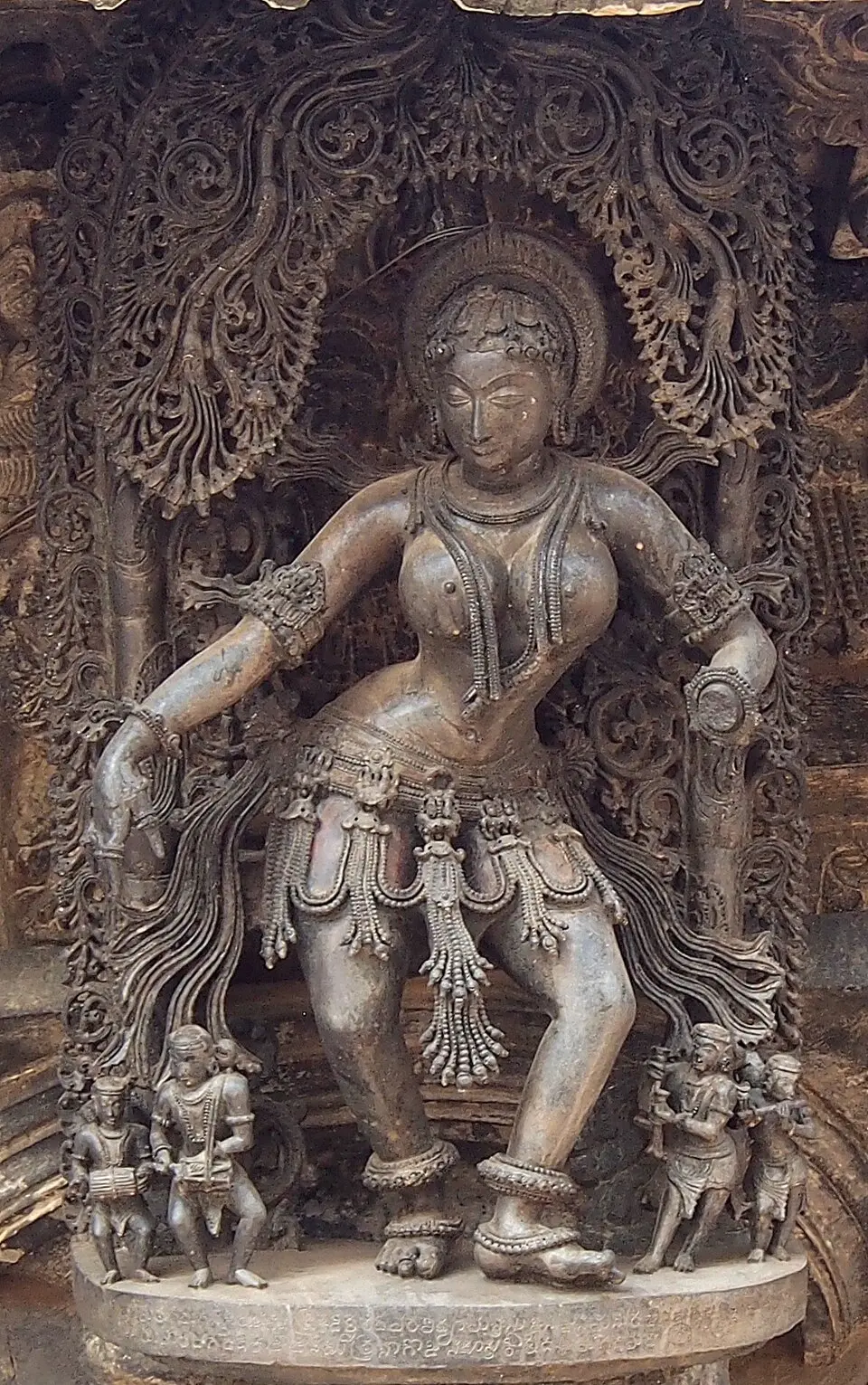
- Vigour. Bodies turn sharply at neck, waist and knee in the tribhanga pose, many figures are seen twisting or from the back, and the relief is cut so deep that figures almost stand free; in changing sunlight they seem to move. The energy does not slacken from one temple to the next, which is the sense in which it is resilient.
- Breadth of life. Gods and goddesses, surasundaris and apsaras, mithunas, mythical vyalas, dancers, musicians, soldiers, hunters, teachers, ascetics and animals all share the same walls, and the Jain Parshvanatha temple uses the same style, which shows a shared workshop serving more than one faith.
- Joy in life. Long limbs, elongated eyes, rich jewellery and absorbed, smiling faces express a confident delight in the human body, held within a religious frame.
- The other side. Critics point out that later figures repeat set formulas, that dense surfaces crowd single figures, and that the ideal of beauty is a type rather than a portrait. On balance the claim holds, because no other school of the period shows so wide a world with such movement.


Hoysala filigree in soapstone
- The Hoysalas carved in chloritic schist, a soapstone that is soft when quarried and hardens with exposure, so sculptors could cut jewellery, hair and foliage almost like metalwork. The bracket figures (madanikas) of Belur show dancers, a huntress and a woman with a mirror, and the friezes of Halebidu run in bands of elephants, lions, horsemen, scrolls and epic scenes. Many sculptors signed their work, such as Dasoja and Mallitamma, which is rare evidence of artisans' names.

Chola bronzes
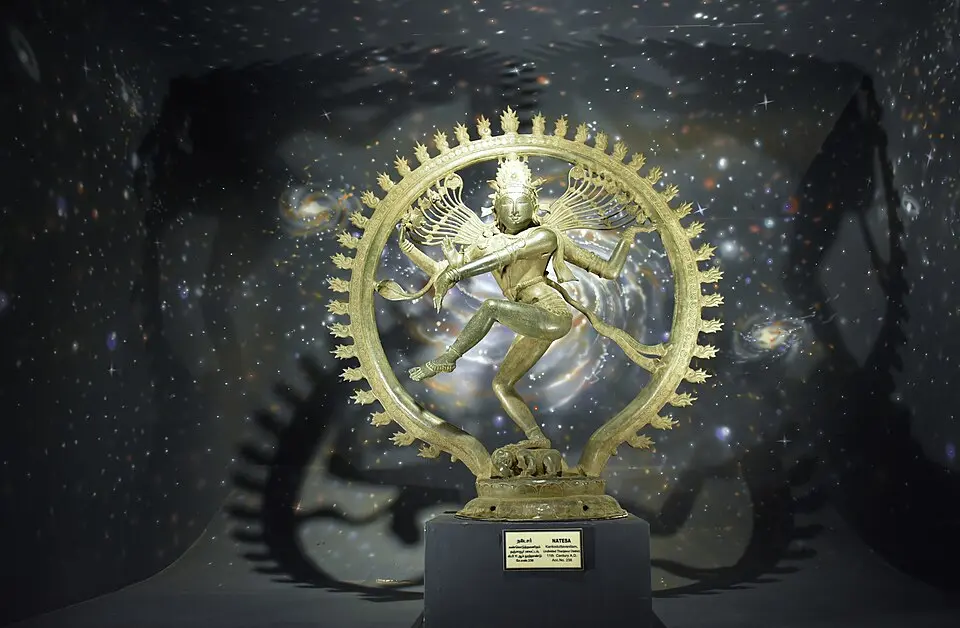
- Chola bronzes of the tenth to thirteenth centuries were cast by the lost wax method (madhuchchhishta vidhana): a wax model is coated in clay, the wax is melted out and molten metal fills the hollow, so each icon is unique. They were made for processions and for the hymns of the Nayanar saints, and royal women such as the Chola queen Sembiyan Mahadevi were major patrons.
- Besides the Nataraja, the main types are Somaskanda (Shiva seated with Uma and the child Skanda, an image of divine family), standing Parvati in a graceful tribhanga, and sets of Rama, Sita and Lakshmana.
- Pala bronzes, made in Bihar and Bengal between about the eighth and twelfth centuries at Nalanda and Kurkihar, show Buddhist and Hindu deities and carried the style to Nepal, Tibet and Southeast Asia.

Dimensions
- Aesthetic. Sculpture follows the idea of rasa, especially shringara (love and beauty), and the tribhanga pose gives a body rest and motion at once.
- Religious and philosophical. Texts on iconometry fixed proportions and attributes, and the four aims of life, dharma, artha, kama and moksha, explain why worldly scenes surround the sacred core.
- Social and economic. Temples employed guilds of sculptors and dancers, and signatures and inscriptions show artisans of standing.
- Technical. Sandstone at Khajuraho, granite in Tamil Nadu and soapstone in Karnataka set the limits of each style, and the bronze caster's alloy and clay were local.
In practice
- The Antiquities and Art Treasures Act, 1972 (Ministry of Culture) bans the export of antiquities without permission and requires their registration.
- Swamimalai bronze icons hold a Geographical Indication (GI) tag, which protects the lost wax craft of the Kaveri delta.
- Case, the Sripuranthan Nataraja. A Chola bronze stolen from a Tamil Nadu temple and sold abroad was returned by Australia in 2014, showing how weak village temple security feeds the art market.
- Case, Bharat Mandapam. For the Group of Twenty (G20) summit in 2023 a 27 foot Nataraja was cast by Swamimalai artisans using the lost wax method, a living link with Chola practice.
Issues and way forward
- Theft and smuggling. Bronzes in remote temples are poorly guarded and undocumented, so they are easy to steal and hard to claim back. The National Mission on Monuments and Antiquities (Ministry of Culture, 2007) set out to document every antiquity, and completing that database, as the Comptroller and Auditor General (CAG) urged in 2013, is the first defence.
- Weathering and careless cleaning. Rain, lichen and harsh cleaning blur fine carving, which calls for scientific conservation by the Archaeological Survey of India (ASI).
- Misreading erotic sculpture. Treating Khajuraho as only erotic hides its breadth, so site guides and textbooks should present the full programme of the walls.
- Fading craft livelihoods. Bronze casters face rising costs and cheap copies; GI enforcement, design support and public commissions keep the skill alive.
Common confusions
- Apsara, surasundari and yakshi. Apsaras are celestial dancers, surasundari is the broader term for celestial beauties on temple walls, and yakshis are earlier nature spirits.
- Mithuna and maithuna. A mithuna is a loving couple, an auspicious motif since early times; maithuna refers to the sexual act itself.
- Chola and Pala bronzes. Chola bronzes are South Indian and mainly Shaiva and Vaishnava; Pala bronzes are from eastern India and largely Buddhist.
- Hazara Rama. It belongs to Vijayanagara in the fifteenth century, not to the Hoysalas.
For the exam
- Keyword bank: surasundari, mithuna, tribhanga, high relief, registers, Lakshmana temple frieze, Hazara Rama procession, Konark musicians, madanika, soapstone filigree, lost wax, Nataraja, Somaskanda, Sembiyan Mahadevi, Pala bronzes.
- Previous year questions: Practise the previous year questions on this topic →
- Use in an answer:
- Introduction (data): Of the 85 temples the Chandellas are believed to have built at Khajuraho, about 25 survive, and their walls hold one of the fullest pictures of medieval Indian life.
- Introduction (judgement, quote or report): The 27 foot Nataraja cast at Swamimalai for Bharat Mandapam in 2023 shows that the Chola lost wax tradition is still a living craft a thousand years on.
- Conclusion: Medieval temple sculpture is a mirror of its society, but a flattering one, which shows courts and festivals more readily than fields and workshops.
- Conclusion: Protecting these images from theft and neglect protects both a record of the past and the livelihoods of the craftspeople who continue it.
Photo credits
Photographs are from Wikimedia Commons; each photo links to its file page, which gives the photographer and licence.